
Food & Water
A cheap emergency food supply your kids will actually eat
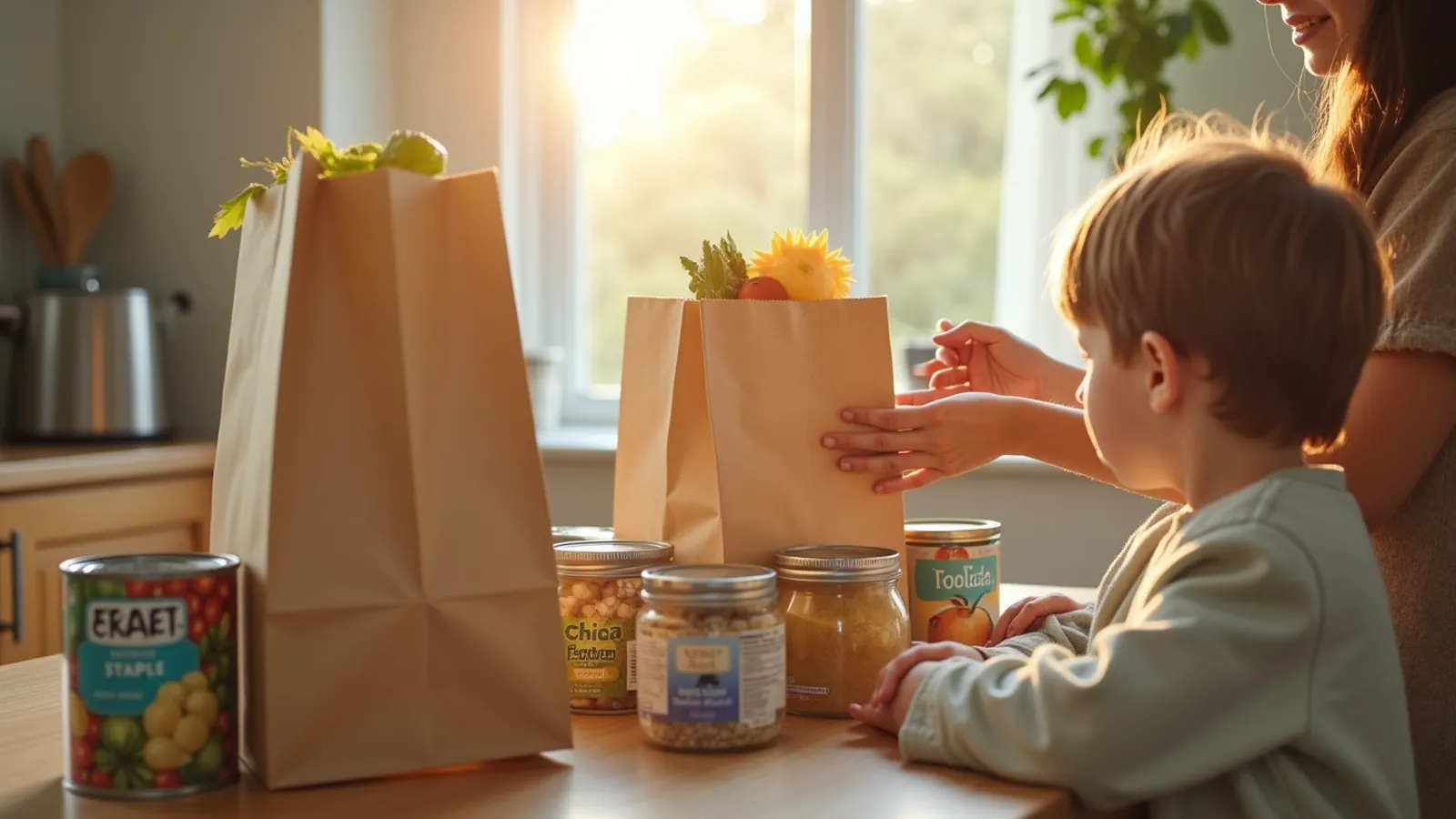
A $50 grocery week and two kids who won't touch a bean is not a reason to skip an emergency food supply. It's a reason to build one out of food they already eat, about $10 at a time.
On this page (11 sections)
- Start with the meals your kids already eat
- The cheap emergency food list for picky kids (a Walmart run)
- $10 a week: ten weeks to two weeks of meals
- The 14-day meal tracker
- Cheap food for emergency meals: making room in a $50 grocery week
- Storing it so it is still good when you need it
- Why this is not another prepper pitch
- When to get help
- Frequently asked questions
- Keep going
- Sources
A $50 grocery week, two kids who won't touch a bean, and a two-week emergency food supply to build: that is the version of getting ready nobody writes a list for. The lists you find are five-gallon buckets of rice and lentils, or a freeze-dried kit sold by the bucket, and you already know how that ends at your table. It sits for three years, nobody eats it, and the money is gone.
There is a cheaper way that holds up. Build a cheap emergency food supply out of meals your kids eat on an ordinary Tuesday, and add about $10 a week to the grocery run you are already making. Below is the category list for a Walmart run, the weekly add-on table, and the 14-day meal tracker that shows you how close you are.
Key takeaways
- Build the supply from food your household already eats. Cheap food nobody eats is the expensive option.
- Add about $10 a week to your normal grocery run instead of spending $100 at once.
- Count in household meals: 14 days of breakfast, lunch and dinner is 42 meals for a household of four, a number you can watch move.
- Buy the size you will actually cook, and compare unit prices on the shelf before you decide.
- Store it in one cool, dry, labeled place with a manual can opener beside it, and eat from it every week.
- Water belongs in the same plan: at least one gallon per person per day for at least three days.
Things this guide mentions
Amazon searches, not product picks: we have not tested what they show. Check the specs and the return policy on each listing before you buy.
Start with the meals your kids already eat
Before you buy anything, write down ten meals your household eats without a fight. Not what you wish they'd eat: what actually gets finished. For most families that list looks like pasta with tomato sauce, macaroni and cheese, peanut butter sandwiches, cereal, oatmeal, quesadillas, canned soup, applesauce, crackers and a chicken-and-rice night.
Now go back and mark the ones that are shelf-stable or can be. Pasta, jarred sauce, boxed mac and cheese, peanut butter, oats, cereal and canned soup all keep for months without a fridge. That marked list is your emergency food supply, and it costs less than a kit because you already buy these things every week.
The rule that saves the most money: if you would not serve it on a normal Tuesday, do not bank it. A can your kid refuses is not food storage; it is a can you will throw away in three years. Picky eating is not a character flaw to fix during an outage. It is a constraint you plan around, the same way you plan around a nut allergy.
Test one can at dinner first
Buy a single can or box of anything you are considering and serve it as part of a normal meal this week. If it fails, it never enters the supply and you are out a couple of dollars. If it works, buy more.
The cheap emergency food list for picky kids (a Walmart run)
This is a category list, not a brand list. Compare unit prices on the shelf and buy the size you will actually cook: store brands are often cheaper per serving, so check the label and the price tag before you decide.
| What to buy | Why picky eaters usually accept it | How it becomes a meal | Check before you buy |
|---|---|---|---|
| Pasta and jarred tomato sauce | Familiar shape, mild sauce | Dinner | Intact jar seals; plain sauce, not chunky |
| Boxed macaroni and cheese | The fallback dinner almost every kid eats | Dinner | Buy extras when it is on sale |
| Canned pasta in sauce | Soft, mild, edible straight from the can | Lunch or dinner | A pop-top helps if the can opener goes missing |
| Peanut butter or sunflower butter | Protein kids eat without negotiation | Sandwich, crackers, stirred into oatmeal | Largest jar you'll finish; nut-free if you need it |
| Oats, rolled or instant | Cheapest breakfast on the list per serving | With peanut butter or shelf-stable milk | A canister goes further than packets |
| Shelf-stable milk (UHT cartons or powdered) | Makes cereal, oats and mac and cheese possible with no fridge | Breakfast and cooking | The date, and rotate it like any other food |
| Cereal | A breakfast nobody argues about | With milk, or dry as a snack | Only a kind they already eat |
| Canned chicken or tuna in water | Protein that hides well in pasta and tortillas | Small amounts in kid meals, more in yours | Cans that are intact, not bulging or leaking |
| Canned fruit in juice, applesauce cups | The familiar thing that gets eaten when everything else is strange | Snack or side | Cups portion better than a big can |
| Instant mashed potato flakes, plus canned corn, peas or green beans | Filling side with no oven and no fridge | Side, or a base under canned chicken | Only the vegetables they already eat |
Notice what is not on the list: nothing that needs a freezer, nothing that needs an oven, and no bucket. Everything there can be eaten cold if the power is out, which matters, because in an outage the cooking equipment is the risky part, not the food.
$10 a week: ten weeks to two weeks of meals
This works on a $50 grocery week because none of it is a separate trip. You buy your normal groceries, then spend about $10 more on shelf-stable food and put it straight into the supply instead of the cupboard. Ten weeks of that is about $100, spread across two and a half months, which is a very different number from $100 today.
The figures below are illustrative. Shelf prices differ by store and change with sales, so use the shape of the table rather than the dollar amounts, and recount with your own receipts.
| Week | About $10 of shelf-stable food (illustrative) | Household meals banked | Running total |
|---|---|---|---|
| 1 | Macaroni and cheese, two cans of the vegetable they eat | 4 | 4 |
| 2 | Pasta, two jars of plain sauce, canned tomatoes | 3 | 7 |
| 3 | Peanut butter, jelly, crackers | 5 | 12 |
| 4 | Oats canister, two cartons of shelf-stable milk | 6 | 18 |
| 5 | Canned pasta in sauce, applesauce cups | 4 | 22 |
| 6 | Canned chicken or tuna, tortillas, canned soup | 3 | 25 |
| 7 | Potato flakes, canned corn, canned peas | 3 | 28 |
| 8 | Cereal, juice boxes, more shelf-stable milk | 4 | 32 |
| 9 | Rice, canned chicken, canned soup | 4 | 36 |
| 10 | Granola bars, canned fruit, extra crackers and peanut butter | 6 | 42 |
"Household meals" means one meal for everyone at the table, not one serving. Fourteen days of breakfasts, lunches and dinners is 42 household meals, or 168 servings if you would rather count plates.
Ring up the $10 separately
If the shelf-stable food goes into the same cart as this week's milk and bread, it gets eaten this week. Ring it up as its own transaction, carry it home, and put it on the supply shelf before anything else is unpacked.
If ten weeks feels long, do two weeks at $20 and then $10 after that. The point is the direction, not the schedule. A supply that grows every week beats one you keep meaning to start. If you want a different shape of list, the emergency food supply list covers a full two-week pantry, and emergency food on a budget goes deeper on the weekly math.
The 14-day meal tracker
An emergency food supply is easy to buy and hard to finish, because "some food in the closet" never tells you whether you are done. Count it instead. For a household of four, two weeks is 14 breakfasts, 14 lunches and 14 dinners: 42 household meals.
Work through this on the page itself, one line at a time, and come back to it after each $10 week.
- A shelf, tote or box out of the sun and away from heat, labeled with the month you started.
- 14 breakfasts banked, plus the shelf-stable milk or juice that goes with them.
- 14 lunches banked: peanut butter, crackers, tortillas, canned pasta, applesauce.
- 14 dinners banked: pasta and sauce, mac and cheese, canned soup, canned chicken, potato flakes.
- At least two meals per kid that need no cooking at all.
- A manual can opener within arm's reach of the shelf.
- Water: at least one gallon per person per day for at least three days, stored where you can get to it.
- A separate snack and treat box, so the treats do not get eaten as meals.
A household of four that follows the table above ends week 10 with 42 household meals banked for about $100, plus whatever water they already store. If the power goes out on a Tuesday, that is breakfast, lunch and dinner for 14 days without a trip to the store.
Keep the tracker where the food is. A count on a shelf gets updated; a count in an app gets forgotten. When you buy a week's add-on, add its meals to your running total that same afternoon.
Cheap food for emergency meals: making room in a $50 grocery week
- Store brands first. They are often cheaper per serving; check the label and the unit price, and if the kids don't notice a swap, that is your $10 working harder.
- Unit price, not package price. The bigger canister of oats beats the box of packets, and a larger bag of pasta beats the small box, as long as you will actually cook it.
- One swap a week. Take one convenience item off the list for a month and put that money into the shelf instead. That is how the $10 appears without touching the rest of the budget.
- Buy the sale, not the list. If macaroni and cheese is marked down, buy two weeks' worth and skip the row you had planned. The tracker counts meals, not a script.
- Skip the gear. You do not need a generator to feed your family for two weeks. You need food they will eat, a manual can opener, water, and a way to hear the weather. Gear can come later, if it comes at all.
Water is the other half of the supply and the cheapest part of it: tap water in clean, food-grade containers. The container rules, sizes and rotation schedule are in emergency water storage, and the Food and Water section puts the whole supply in order.
If your kitchen doesn't have one, a manual can opener is the one item worth buying before anything else on this list, because the electric one does nothing when the power is out.
Search manual can openers on Amazon (Amazon, affiliate link) opens in a new tab
Storing it so it is still good when you need it
One place, one shelf, cool and dry, away from the oven, the furnace and direct sun. Label the start month on the box so you can see how old the supply is at a glance, and eat from it every week: a jar of sauce you use and replace is a jar you know is fresh. A food storage can rotation system keeps the oldest cans at the front.
The federal kit list starts with at least a three-day supply of non-perishable food and a manual can opener; building toward two weeks is the same idea, extended. Review the shelf when the clocks change in spring and fall, because it is the twice-a-year reminder UConn Extension suggests for the whole kit.
Check cans before you use them. If a can is bulging or leaking, throw it out without opening it, and do not taste or smell it to decide. When in doubt, throw it out.
Home-canned food follows different rules. Store jars between 50 and 70 °F [10 and 21 °C] for best quality and never above 95 °F [35 °C], and store them without ring bands so a broken seal is easier to spot. If a jar is unsealed, spurts when you open it, or has mold on the food or under the lid, do not taste it: the National Center for Home Food Preservation says to treat suspect jars of low-acid food as having produced botulism toxin and handle them accordingly. When in doubt, throw it out.
Cooking during an outage
Cook outdoors. A camp stove, grill or generator used in a kitchen, garage (even with the door open), basement or crawl space can produce carbon monoxide, which you cannot see or smell. Keep generators at least 20 feet from doors, windows and vents (CDC), and install battery CO alarms. If an alarm sounds, get everyone outside first, then call 911 from outdoors.
- If you missed a $10 week
- Skip it and carry on next week. The tracker already shows what you have, and a supply built over fourteen weeks is the same supply.
- If the shelf got hot, a garage in July or a cupboard over the stove
- Move it. Heat cuts storage quality fast, and home-canned jars stored above 95 °F lose quality in weeks rather than months.
- If a kid refuses a meal during the outage
- That is the whole reason for a familiar-food shelf. Keep one guaranteed meal per kid that does not depend on negotiation.
Why this is not another prepper pitch
If you have landed on pages like this before and closed the tab, that instinct is reasonable. Too many of them end with expensive gear and no way to tell whether any of it is true. Here is what this page actually is.
There are no product picks, ratings or prices here, because we have not bought or tested a single thing on this list. The site earns, if it earns at all, from labeled Amazon search links and clearly marked affiliate links on review pages. The gear pages explain what to look for and let you choose; no page here tells you a product works.
The canning question is the fair one, and it has a plain answer. Tested canning depends on two things: acidity and temperature. Vegetables, meat, poultry, seafood, beans and soups are low-acid foods with a pH above 4.6, and in a sealed jar that is exactly the environment where botulism spores can grow: moist, low-acid, little oxygen, between 40 and 120 °F [4 and 49 °C]. Those spores are destroyed at 240 to 250 °F [116 and 121 °C], which a pressure canner reaches at 10 to 15 PSIG. In boiling water, the same low-acid food would need 7 to 11 hours. That gap is why oven canning, open-kettle processing, inversion seals, dishwasher canning, paraffin and steam canning of low-acid food are not shortcuts.
Every canning guide on this site uses USDA and National Center for Home Food Preservation tested recipes, with the processing time adjusted for your altitude, and says so on the page. No food-safety professional reviews these guides, as how we write explains, and each page lists its sources so you can open the USDA or NCHFP page yourself and compare.
When to get help
Call for help if
- A carbon monoxide alarm sounds while you are cooking outdoors or running a generator: get everyone outside first, then call 911 from outdoors.
- Anyone has trouble breathing, double vision, weakness or vomiting after eating home-canned food: treat it as an emergency and call 911 or your health care provider right away.
- Your water system issues a boil water notice: follow it exactly and call the number on the notice before you use the tap for drinking, ice or dishes.
- You cannot afford both food and water storage this month: contact your local emergency management office or 211 for local food resources rather than choosing between them.
Who to ask. In an emergency, call 911. If a carbon monoxide alarm sounds or anyone feels dizzy, sick or confused, get everyone outside into fresh air first, then call 911. Report outages and downed power lines to your utility. For local hazards, shelters and alerts, contact your city or county emergency management office (start at Ready.gov).
Frequently asked questions
What counts as cheap emergency food for a picky household?
The shelf-stable version of meals your household already eats: pasta and sauce, boxed mac and cheese, peanut butter, oats, cereal, canned soup, canned fruit and shelf-stable milk. Bought as a $10 add-on to your normal grocery run, ten weeks gets a family of four to roughly two weeks of meals. Food your kids refuse has no value in an outage, whatever it cost.
Where can I find emergency food cheap enough for a $50 grocery week?
At the store you already shop, in the same aisles. Add about $10 to your normal trip and put it straight on the supply shelf. Compare unit prices and buy the size you will actually cook, and hold off on freeze-dried kits and bulk buckets until you know your household will eat them. Count your own receipt rather than someone else's list.
How do I know home-canned food in my supply is safe?
It is safe when it was made with a tested recipe, processed by the correct method for its acidity, for the full time, with the time adjusted for your altitude: pressure canning for low-acid foods, boiling water for properly acidified high-acid foods. Store jars between 50 and 70 °F, without ring bands, and check each seal before use. If a jar is unsealed, spurts or shows mold, do not taste it. When in doubt, throw it out.
Ready to compare?
The same searches, in one place. Use the checklist in this guide when you compare listings, and buy only what fills a gap in what you already have.
Sources
- Emergency Supply Kit, UConn Extension (accessed October 30, 2026).
- Ensuring Safe Canned Foods, National Center for Home Food Preservation (accessed October 30, 2026).
- Storing Home Canned Foods, National Center for Home Food Preservation (accessed October 30, 2026).
- Carbon Monoxide (CO) Poisoning Basics, Centers for Disease Control and Prevention (accessed October 30, 2026).
- Build A Kit, Ready.gov, FEMA (accessed October 30, 2026).
Food and water, in the right order
The Food and Water section puts storing, rotating and treating water next to the budget food guides, so you can build the whole supply a step at a time.