
Food & Water
Food storage can rotation: a first-in, first-out shelf that stays edible
The oldest can should always be the easiest can to reach, and everything new should go behind it. Here is the loading rule, a use-by sticker layout you copy by hand, and a four-item check tied to four dates on the calendar.
On this page (12 sections)
- First in, first out: the one rule that runs the shelf
- Food storage can rotation, step by step: set the shelf up in one afternoon
- The use-by sticker layout you copy by hand
- Jars, freezers and stacking: the dates and the limits
- The four-item quarterly check, on a date you will remember
- What this costs, and what you can skip
- "Is this just another preparedness site?" The honest answer
- If this happens, do this
- When to get help
- Frequently asked questions
- Keep going
- Sources
Your emergency shelf has turned into a graveyard: cans a year past their date, crackers gone soft, a bag of rice nobody wants to open. You spent real money to be ready and then watched it go stale, which stings more than never buying it at all.
Food storage can rotation is the fix, and it is smaller than it sounds. The oldest item sits where your hand goes first, everything new goes behind it, and every package gets a date the day it enters the house. Below is the loading rule, a use-by sticker layout you copy by hand, and a four-item check tied to the first Saturday of January, April, July and October.
Key takeaways
- First in, first out: use the older items first and put the new ones behind them (NCHFP).
- Make the oldest item the easiest item to reach — that one design choice runs the whole system.
- Date everything the day it arrives, including home-canned jars and frozen packages (NCHFP).
- Home-canned jars store best at 50–70 °F (10–21 °C), in a clean, cool, dark, dry place, never above 95 °F (35 °C) (NCHFP).
- Freeze and store frozen food at 0 °F (−18 °C) or below (NCHFP).
- A quarterly check tied to a real calendar date is what keeps the dates from drifting.
First in, first out: the one rule that runs the shelf
The National Center for Home Food Preservation puts the rule plainly: follow "first in, first out," and rotate foods so you use the older items first. On a can shelf, that single habit is the difference between a supply and a pile.
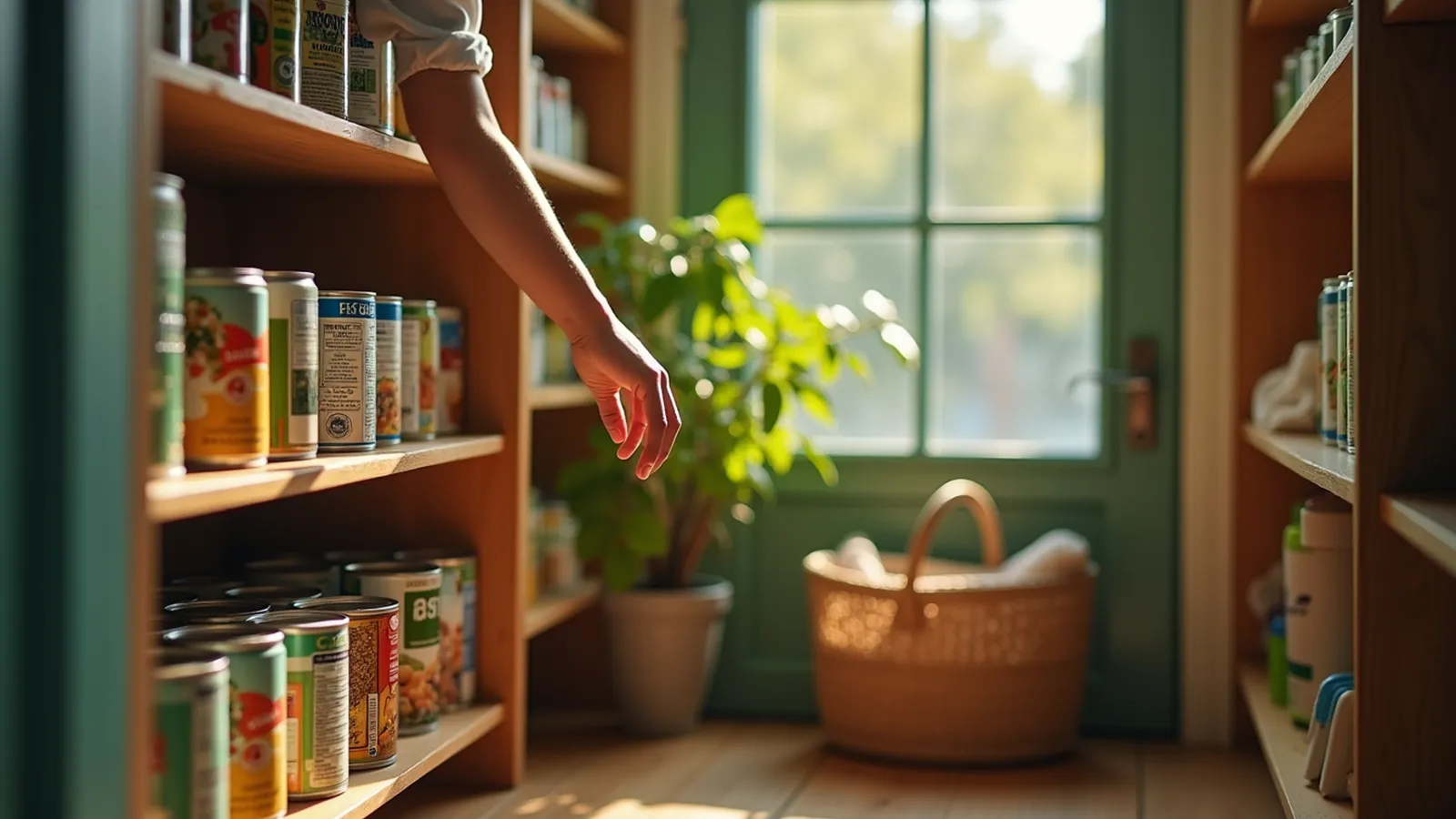
The mechanical problem is reach. On a deep shelf your hand finds the front cans, so the newest food gets eaten and the oldest becomes archaeology. Fix reach and the rule runs itself: whatever should leave first has to be the easiest thing to grab.
| Method | What you need | Works well for |
|---|---|---|
| Rotation rack | A food storage can rotation rack that loads at the back and gives out at the front | A shelf with depth and one can size used often |
| Front row, back row | Two rows and a marker, or a shallow box with the front cut low | Mixed can sizes, small kitchens, rentals |
| Month boxes | One box per month or quarter, dated on the outside | Dry goods, snacks, smaller households |
Pick one method and stop shopping around. A rack is a convenience, not a safety device: it holds cans in order, it does not make food keep longer.
Then stock the meals you already cook. Write down five dinners that get eaten without complaint and buy the ingredients for those and little else. A can nobody will open is a cost with no benefit, however long it keeps — and the National Center for Home Food Preservation makes the same point about preserves: for best quality, can no more food than you will use within a year unless directions for a specific food say otherwise.
Food storage can rotation, step by step: set the shelf up in one afternoon
Do this once, properly. After that it is a two-minute habit at grocery time plus a half hour, four times a year.
Empty the shelf and sort into three piles
Keep, eat this week, out. Do not taste anything to decide: the National Center for Home Food Preservation says plainly not to taste food from a jar with an unsealed lid or food that shows signs of spoilage. If you cannot tell whether something is safe, it goes out — one can costs less than being wrong.
Done when: the shelf is empty and the out bag is by the door.
Check the spot before anything goes back
The National Center for Home Food Preservation says to store canned food in a clean, cool, dark, dry place, gives 50–70 °F (10–21 °C) for best quality, and says not to store jars above 95 °F (35 °C) or near hot pipes, a range, a furnace, an uninsulated attic or direct sunlight. Dampness corrodes metal lids, breaks seals and allows recontamination. A hot garage shelf in July is the wrong home for home-canned jars; a closet floor or an interior cupboard is the right one.
Done when: you would be comfortable storing chocolate there.
Date every item before it goes back on the shelf
Copy the date already printed on the can or box; for a home-canned jar, write the recipe and the date you canned it. The sticker layout is two sections down.
Done when: every package has a readable date someone can see without picking it up.
Load from the back
Oldest to the front, newest behind, in whichever of the three methods you chose. If two cans carry the same date, the one you like less goes in front.
Done when: the front row is visibly the oldest food you own.
Write the one-page shelf list and set four dates
Three columns — what it is, roughly how many, the oldest date — taped inside the cupboard door. That page is what you check at the store instead of guessing. Then add the four quarterly checks to your phone and to the paper calendar on the fridge before you close the door.
Done when: the list matches the shelf and four reminders exist, one of them less than a month away.
The use-by sticker layout you copy by hand
There is nothing to download or print here. Take a sheet of address labels, or a roll of masking tape and a permanent marker, and copy this five-line layout by hand. One label per item, written as the item comes into the house, is the whole discipline.
| Line | What you write | Example |
|---|---|---|
| 1 — large | Month and year the item joined the shelf | 10 / 2026 |
| 2 | What it is, in plain words | Black beans |
| 3 | The date already printed on the package, copied exactly | Printed: 03 / 2028 |
| 4 | Your own eat-by target, set earlier than the printed date | Eat by 09 / 2027 |
| 5 | Recipe or source, for home-canned and home-frozen food | NCHFP recipe, batch 2 |
Line 4 is what makes the system work. The printed date belongs to the manufacturer; the eat-by target belongs to you, and setting it earlier gives you a season of slack instead of a scramble. Line 5 matters most for home-canned jars, because a batch is only as good as the recipe behind it — and if that recipe was not a tested one, the jar should not be on the shelf at all.
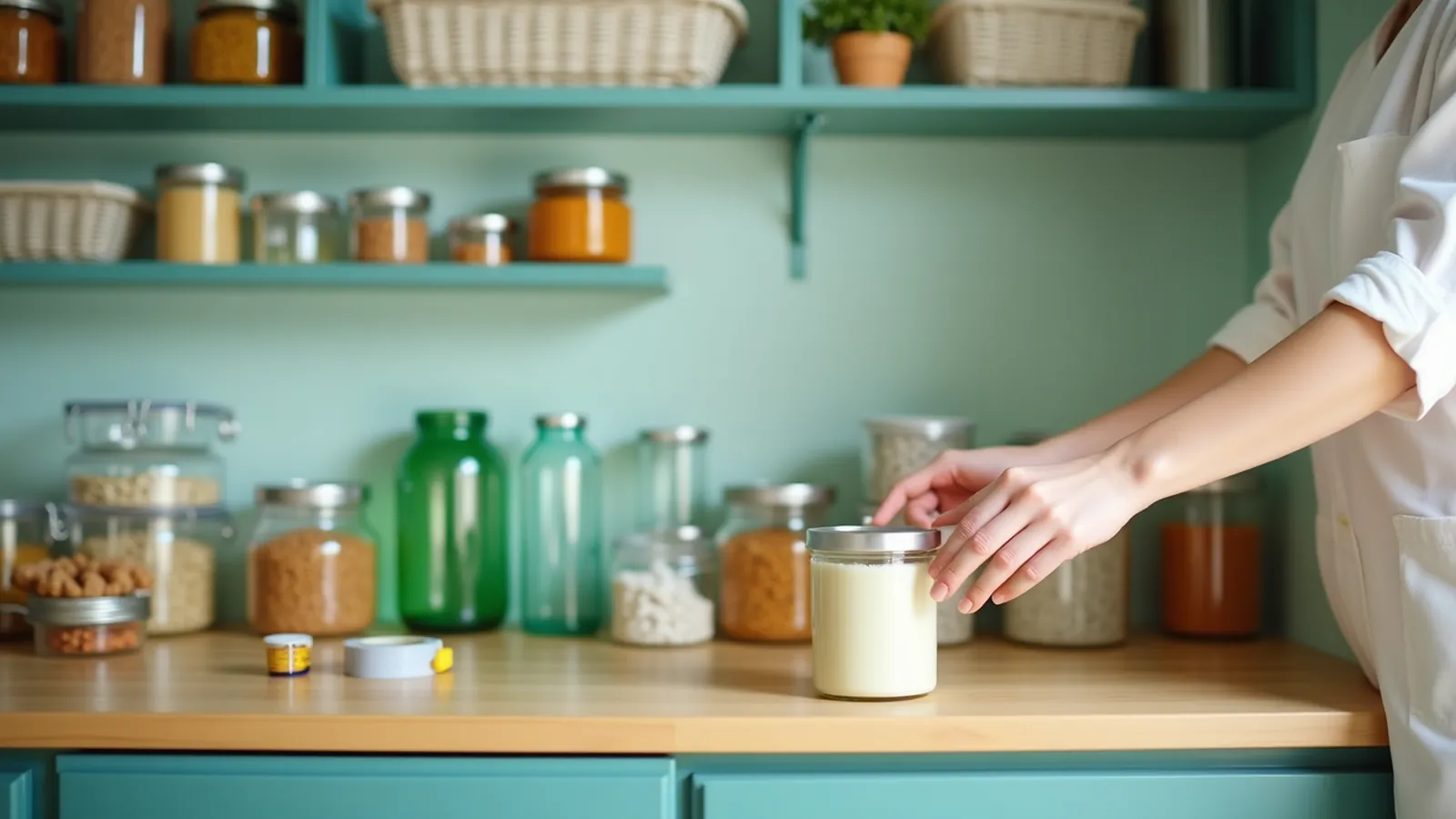
On jars, write on the lid or on a strip of tape on the side rather than straight onto the glass. The National Center for Home Food Preservation advises cleaning lids and jars of food residue before storage, and says jars are best stored without ring bands so a broken seal is easy to spot.
A household pressure cans crushed tomatoes in late August with a tested recipe and writes on each lid: "TOMATOES — 08 / 2026 — batch 2." On the one-page shelf list the jars sit in the October group, so the October check moves them to the front row and they get eaten long before the next August batch arrives.
Jars, freezers and stacking: the dates and the limits
Store-bought cans and boxes get the printed date copied exactly. Home-canned jars get the recipe name and the date you canned them (NCHFP). Frozen packages get the product name, any added ingredients, the packaging date, the amount or servings, and the form of the food (NCHFP). Repackaged dry goods get what it is and the date you bought it; pet food gets the date bought, with the oldest bag or can in front.
Stacking needs a little care. The National Center for Home Food Preservation warns that stacking can disturb vacuum seals, says not to stack jars too high directly on top of each other, and notes one manufacturer recommends no more than two layers with support between them.
In the freezer, the times below are approximate months of storage at 0 °F (−18 °C), assuming the food was prepared, packaged and stored correctly, and they assume the food was properly blanched. Use the shorter end of a range when you set your eat-by target.
| Food | Months at 0 °F |
|---|---|
| Fruits and vegetables | 8–12 |
| Poultry | 6–9 |
| Fish | 3–6 |
| Ground meat | 3–4 |
| Processed meat | 1–2 |
Those are quality windows, not safety deadlines: past them the food should still be safe, just lower in quality (NCHFP). That is exactly why the label earns its keep. A dated package gets eaten while it is good; an unlabeled one gets doubted and thrown out.
The four-item quarterly check, on a date you will remember
A reminder that says "check the food storage" gets ignored. A reminder tied to a date you already think about — the first Saturday of January, April, July and October — gets done, because the date arrives whether you are ready or not. Set it for a morning, put the kettle on, and work through the checklist below.
Walk the shelf front to back
Pull anything past its eat-by target, anything with a damaged or leaking package, and any home-canned jar whose lid is not sealed. The National Center for Home Food Preservation notes that a lid center that is flat or bulging may not be sealed, and says not to taste such a jar to decide.
Done when: the front row has been checked jar by jar and the discards are out of the cupboard.
Cook one whole meal from the shelf
Not a taste test — dinner. This proves the supply is food rather than furniture, and it shows you which items nobody in the house will eat.
Done when: a meal has been served and the ingredients are on the shopping list to replace.
Rewrite the one-page list
Update the counts and the oldest dates, add a short "buy next" note for the gaps, and put the page back inside the cupboard door.
Done when: the list matches the shelf and there is a shopping note.
Check the storage spot itself
Look for heat, damp, sunlight and pests. The National Center for Home Food Preservation warns that dampness can corrode metal lids, break seals and allow recontamination — so a shelf that keeps getting damp needs a new location, not a new label.
Done when: the spot is still clean, cool, dry and out of the light.
Then the weekly habit that keeps the quarterly check short: when groceries come in, the new cans go behind the old ones before the bags are unpacked. That is the entire food storage rotation system — the quarterly check only catches what the weekly habit missed. Amounts and shopping lists are in the emergency food supply list, and the food and water section shows where the shelf fits in the rest of the plan.
What this costs, and what you can skip
The honest budget answer is a marker and a roll of tape. That is the rotation system. A rack, a shelf or a set of matching containers is comfort: none of it changes the rule, and none of it makes a single can last longer.
Stay free for a month first. Load the shelf from the back, date the cans with tape, run one quarterly check, and see whether the system holds in your kitchen. If a rack would genuinely make the front row easier to reach, look at one then — and only one. This page names no products and quotes no prices; what to look for in storage containers is on the storage container guide and the gear pages.
What you do not need for any of this: a generator, a bulk bucket of food your household will not eat, an app or a subscription. The same rotate-and-replace idea applies to your water — emergency water storage covers the amounts and the dates.
"Is this just another preparedness site?" The honest answer
It is a fair question, and the answer should be checkable rather than reassuring. Preparedness content has a reputation for a reason: a scare, a shopping cart and a bucket nobody eats.
The canning rules here come from USDA and the National Center for Home Food Preservation, not from opinion. Low-acid foods — vegetables, meat, poultry, seafood, beans, soups — are pressure canned with a tested recipe and a processing time adjusted for altitude. Untested methods appear on the site only in a sentence that warns against them. Botulism is prevented by three things, and the pages say so plainly: a tested recipe, the correct method, and the correct time and altitude. A suspect jar is handled the way the NCHFP says to handle it, never by tasting or sniffing it.
Follow the source, not the site. Every number on this page is linked at the bottom, and the NCHFP publishes its guidance free at nchfp.uga.edu. That is the test worth applying to any page, including this one: does it name where the rule came from, and can you open it?
Where the money is: clearly labeled Amazon search links on gear pages and one labeled affiliate link on a single review page. Guides like this one name no products and quote no prices. No food-safety or emergency-management professional reviews these pages — the About page says so, and the canning guidance is written against the cited sources rather than signed off by an outside specialist.
If this happens, do this
- If a home-canned jar did not seal
- Reprocessing is not recommended because of quality loss, but the NCHFP allows it within 24 hours if the first attempt used an up-to-date tested recipe: empty the jar into a pot, heat to boiling, pack into a clean jar with a new lid and reprocess as a hot pack. Otherwise refrigerate the jar and eat the contents within a week, or freeze them for up to a year with headspace adjusted to 1 inch.
- If the first attempt did not follow a tested recipe
- The NCHFP is direct: all jars from that batch, sealed or unsealed, may be unsafe and should be discarded. A better label will not fix a method problem.
- If a jar's lid center is flat or bulging
- It may not be sealed. Do not taste it to find out. Follow the NCHFP's spoilage guidance, and when you are unsure, throw it out.
- If a jar on the shelf froze
- Accidental freezing does not cause spoilage unless the jar becomes unsealed and recontaminated, though it may soften the food (NCHFP). If the spot can freeze again, wrap the jars in newspaper, box them and insulate, or move them somewhere warmer but still cool.
- If the shelf keeps filling with food nobody eats
- Cut the stock back to meals you actually cook. The NCHFP's rule for home-canned food — can no more than you will use within a year — applies to everything else on the shelf too.
Storage conditions matter for more than cans. If your cool-storage plan runs to a cellar or garage, the root cellar basics guide covers temperature and humidity, and pressure canning for beginners covers the tested method behind the jars on the shelf.
When to get help
Call for help if
- Anyone becomes ill after eating home-canned, home-frozen or stored food: call a health care provider, or 911 if it is serious.
- You are unsure whether a jar or can is safe and the decision feels like a guess: your local Cooperative Extension office and the National Center for Home Food Preservation publish spoilage guidance, and a call is cheaper than a risk.
- A pet has eaten spoiled or discarded food from the bag by the door: call your veterinarian.
- Your storage cupboard or cellar has been flooded, or the food in it was touched by floodwater: check the USDA FSIS and FoodSafety.gov guidance on flood-affected food, and throw out anything that cannot be cleaned or that is not in a waterproof container.
Who to ask. In an emergency, call 911. If a carbon monoxide alarm sounds or anyone feels dizzy, sick or confused, get everyone outside into fresh air first, then call 911. Report outages and downed power lines to your utility. For local hazards, shelters and alerts, contact your city or county emergency management office (start at Ready.gov).
Frequently asked questions
What is a food storage can rotation rack, and do I need one?
A food storage can rotation rack holds cans in a sloped channel so new cans load at the back and the oldest rolls to the front. It solves the reach problem, which is the real reason cans expire. You do not need one: a shelf loaded front to back, a shallow box with the front cut low, or month boxes do the same job with a marker and tape.
How often should I rotate food storage?
Continuously, then formally. Every time groceries come in, new items go behind old ones. Then run a fuller check four times a year, on a fixed date such as the first Saturday of January, April, July and October, to pull anything past its target and rewrite the one-page shelf list.
How do I set up a food storage rotation system in a small kitchen?
Choose one shallow shelf or the bottom of a closet, sort it into keep, use this week and out, check that the spot is cool, dark and dry, and date every item before it goes back. Load oldest to the front, tape a one-page list inside the door, and put four quarterly reminders in your phone.
Should I write the date on home-canned jars?
Yes. The NCHFP advises labeling and dating jars and storing them in a clean, cool, dark, dry place, ideally 50–70 °F (10–21 °C) and never above 95 °F (35 °C). Write the recipe name and the date you canned it, so the note tells you which jar to eat first.
How do I know the canning advice here is tested, not just blog opinion?
Check the source rather than the site. The canning guidance follows USDA and National Center for Home Food Preservation tested methods, and each page links the specific document it relies on so you can open the original. Low-acid foods are always pressure canned with a tested recipe and an altitude adjustment, and untested methods are named only to warn against them.
Sources
- Storing Home Canned Foods, National Center for Home Food Preservation (accessed October 30, 2026).
- How Long Can I Store Frozen Foods, National Center for Home Food Preservation (accessed October 30, 2026).
- Freezing Pointers, National Center for Home Food Preservation (accessed October 30, 2026).
- Blanching Times, National Center for Home Food Preservation (accessed October 30, 2026).
Put the shelf inside the rest of the plan
The Food and Water section sets storing, rotating and replacing food and water in order, with the food-safety and canning guides next to them.