
Food & Water
Emergency water storage chart: how much your household needs, pets included
One gallon per person per day is the starting rule. Here is the chart that turns it into a number for your home, pets included, and a plan you can start this weekend.
On this page (12 sections)
- Why emergency water advice seems to contradict itself
- Emergency water storage chart: gallons for 3 days and 2 weeks
- How to store emergency water: the step-by-step plan
- Store-bought or self-filled: which to choose
- If your water comes from a well
- Disinfecting water when you have to
- Emergency water sources already in your home
- Troubleshooting stored water
- When to get help
- Frequently asked questions
- Keep going
- Sources
If the numbers you have read don't match and you still don't know how much to store for the dog, here is the plain answer for emergency water storage: store at least 1 gallon of water per person per day for at least 3 days, and work toward 2 weeks, as the CDC advises. Add about a gallon a day for each pet, and more for hot weather, nursing, illness or a home on a well with an electric pump.
This is ordinary readiness for storms and outages, not a bunker project. The numbers only look contradictory because they measure different things. Below is a chart for your household, a weekend plan and the rotation dates, checked against the CDC, Ready.gov, the EPA and Cooperative Extension. You don't need special gear: sealed bottled water or sanitized soda bottles both count.
Key takeaways
- Store at least 1 gallon per person per day for 3 days, and aim for 2 weeks (CDC).
- Count pets too: the CDC recommends 1 gallon a day for most common household pets, according to Oregon State University Extension.
- Store more in hot weather (Ready.gov says needs can double) and for children, nursing mothers and anyone who is sick.
- Commercially bottled water: keep it sealed and follow its date. Water you bottle yourself: replace it every 6 months (CDC).
- Keep containers cool (50 to 70 °F, or 10 to 21 °C), dark and away from gasoline and pesticides (CDC).
Start this weekend
- Work out your number with the chart below (people plus pets, times days).
- Buy or fill 3 days first; build toward 2 weeks over the next few shopping trips.
- Label each container "drinking water" with the date and set a 6-month phone reminder.
Why emergency water advice seems to contradict itself
Three different measurements get quoted as if they were the same:
- Drinking only. Ready.gov says a normally active person needs about three quarters of a gallon of fluid a day, and the American Red Cross puts drinking water at least two quarts (half a gallon).
- Drinking plus basic sanitation. The 1-gallon rule from the CDC and Ready.gov covers drinking, cooking, brushing teeth and basic hygiene. Plan with this one.
- A more generous allowance. University of Florida IFAS Extension suggests 1 to 1.5 gallons per person per day, and more with children, sick people or nursing mothers at home.
Start with 1 gallon per person per day, the official minimum, then add extra where your household needs it. Ready.gov notes that in very hot temperatures, water needs can double.
Pets are the other gap. Oregon State University Extension cites the CDC's recommendation of 1 gallon a day for most common household pets, while UF/IFAS suggests a quart to a gallon per pet depending on size. A full gallon per pet keeps the math simple; if you are short on space, a small cat may need closer to a quart and a large dog the full gallon (UF/IFAS). The pet emergency kit guide covers the rest.
Emergency water storage chart: gallons for 3 days and 2 weeks
The formula is short: (people + pets) x days = gallons. The chart uses 1 gallon per person or pet per day. Oregon State Extension notes that 2 weeks means 14 gallons per person and per pet.
| Household | Gallons per day | 3 days | 2 weeks (14 days) | 2 weeks in very hot weather (doubled) |
|---|---|---|---|---|
| 1 adult | 1 | 3 | 14 | 28 |
| 2 adults | 2 | 6 | 28 | 56 |
| 2 adults + 1 dog | 3 | 9 | 42 | 84 |
| Family of four | 4 | 12 | 56 | 112 |
| Family of four + 1 dog | 5 | 15 | 70 | 140 |
| Family of four + 1 dog + 1 cat | 6 | 18 | 84 | 168 |
Oregon State Extension translates 2 weeks for one person into containers: two 7-gallon camping-style jugs, 14 one-gallon jugs, 27 two-liter bottles or 53 one-liter bottles. Water weighs about 8.3 pounds per gallon (Oregon State Extension), so 15 gallons is roughly 125 pounds: spread it across containers you can lift. The guide to choosing water storage containers compares jugs, bottles and barrels.
A family of four with a dog lives on a well with an electric pump. Their 3-day target is 15 gallons. The first weekend they buy two cases of sealed bottled water and fill six sanitized 2-liter soda bottles from the tap. On the next two grocery trips they add a 7-gallon jug, filled at home and dated. They keep adding toward the 2-week target of 70 gallons, stored in a cool closet and under beds, with a reminder to refill the home-filled containers in 6 months.
How to store emergency water: the step-by-step plan
Decide your target
Use the chart: 3 days first, then 2 weeks, with extra for heat, nursing or illness.
Start with sealed bottled water if you can
The CDC calls unopened, commercially bottled water the safest and most reliable source in an emergency. Keep it in the sealed original container in a cool, dark place (Ready.gov) and observe its expiration date (CDC).
Choose safe containers for water you bottle yourself
The CDC recommends FDA-approved food-grade water storage containers. Otherwise, choose one with a tight top, made of durable, unbreakable material (not glass). Never use a container that held toxic chemicals such as bleach or pesticides. Clean 2-liter soda bottles work (Oregon State Extension, UF/IFAS); milk jugs do not, because milk residue is hard to remove (American Red Cross) and the plastic is made to break down over time (Oregon State Extension).
Wash, sanitize and fill
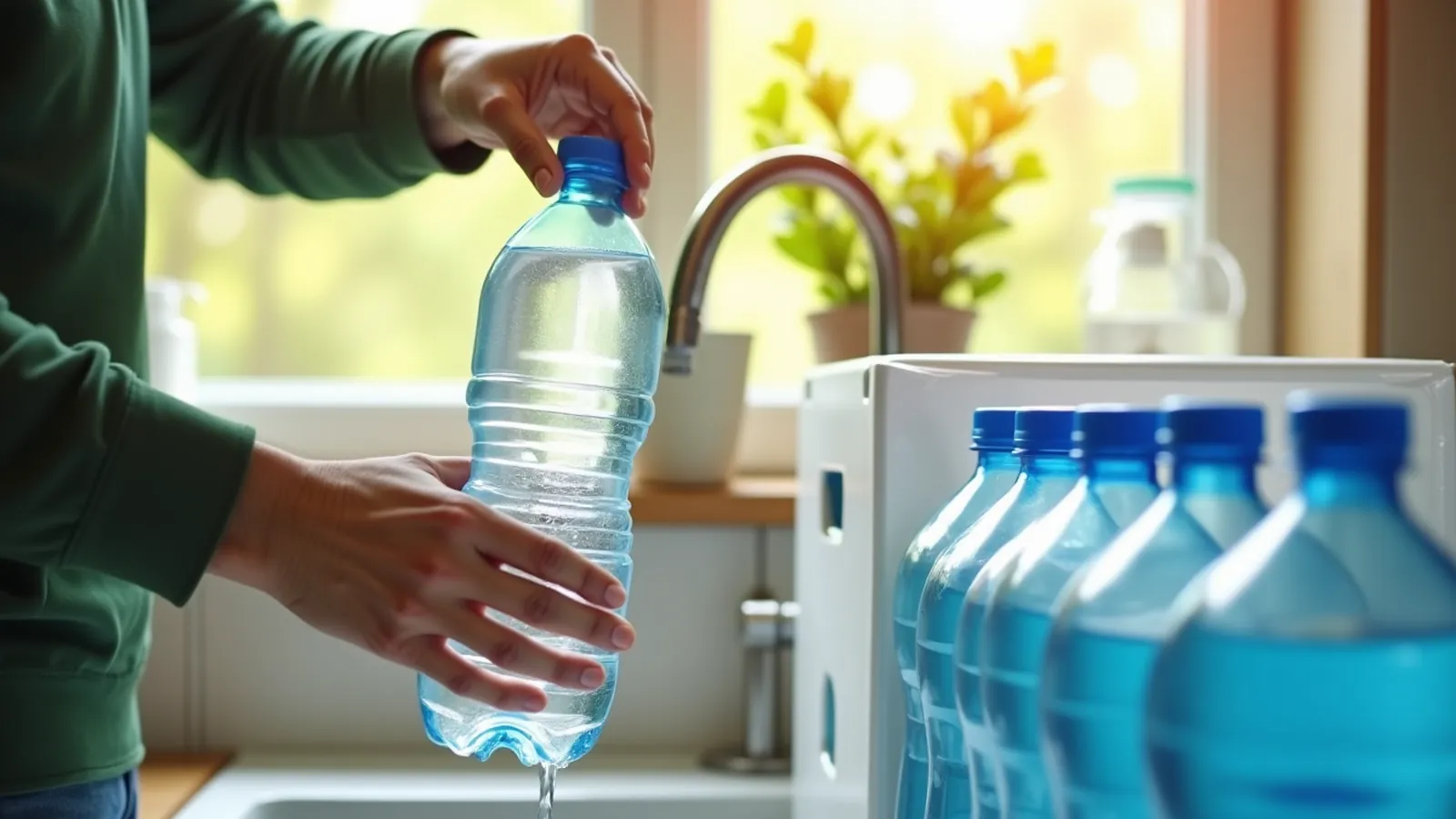
The CDC's steps: wash the container with soap and rinse it. Mix 1 teaspoon of unscented liquid household chlorine bleach (5% to 9% sodium hypochlorite) in 1 quart (4 cups) of water, pour it in, cap and shake so it touches every surface, wait at least 30 seconds, pour it out and let the container air-dry. Then fill it with clean water and close it tightly. Treated city tap water needs nothing added (Oregon State Extension).
Label, date and store
Write "drinking water" and the date on each container (CDC). Store between 50 and 70 °F, out of direct sunlight and away from gasoline, pesticides and other toxic substances (CDC).
Rotate on a schedule
Replace water you bottled yourself every 6 months (CDC, Ready.gov). Use the old water for plants or cleaning (Oregon State Extension), then sanitize and refill. UF/IFAS and Virginia Tech Extension give 6 to 12 months; 6 is the simpler date to remember.
A budget way to reach your first 3 days
- Rinse and sanitize the 2-liter soda bottles already in your recycling bin, then fill them from the tap.
- Add one case of sealed bottled water per grocery trip until the 3-day number is covered.
- Fill empty freezer space with plastic bottles of water: they keep the freezer colder in an outage and become drinking water as they melt.
- Buy a larger food-grade jug only when the free options run out.
Water is the first job on the Food and Water start-here page; food comes next, with the emergency food supply list.
Store-bought or self-filled: which to choose
| Option | Shelf life | Cost | Best for |
|---|---|---|---|
| Commercially bottled, sealed | Follow the label date (CDC) | Costs more, no prep | The first 3 days and a grab-and-go kit |
| Self-filled food-grade jugs or soda bottles | Replace every 6 months (CDC) | Tap water is cheap; bottles can be free | Building toward 2 weeks on a budget |
| Frozen water in the freezer | Rotate like other self-filled water | Free if you have freezer space | Keeping the freezer cold in an outage, then drinking as it melts (Oregon State Extension); use plastic, not glass (UF/IFAS) |
If your water comes from a well
Virginia Tech Extension notes that a power outage can leave well pumps unable to work, so your stored water is your whole supply until the power returns.
- Well water is not chlorinated like city water, so Oregon State Extension and UF/IFAS say to purify it before you store it: boil it, or add unscented bleach at the disinfection dose in the EPA table below (8 drops of 6% bleach per gallon).
- When a storm is forecast, fill the bathtub too. Virginia Tech Extension says tub water is hard to keep clean, so it is for washing, flushing and pets, not drinking unless you treat it first.
- If a generator runs the pump, the CDC says to use it only outside, never in your home or garage even with doors open, more than 20 feet from windows, doors and vents, with a battery-powered or battery backup carbon monoxide (CO) detector inside. The power outage checklist has the full safety list.
- If your well floods, the EPA says to disinfect and test the well water afterward and to contact your state or local health department.
Disinfecting water when you have to
If your stored water runs out and you must use water of uncertain quality, boiling is the safest method (Ready.gov). The EPA says to bring water to a rolling boil for at least one minute, or three minutes above 5,000 feet; Oregon State Extension uses 6,500 feet as the cut-off, so at high altitude, boil for three minutes to be safe.
If you can't boil, use plain unscented chlorine bleach, stored at room temperature for less than a year (EPA). You may have seen 16 drops per gallon quoted in older guidance, such as the 2006 Red Cross and FEMA booklet. The current EPA table:
| Water | 6% bleach | 8.25% bleach |
|---|---|---|
| 1 quart or liter | 2 drops | 2 drops |
| 1 gallon | 8 drops | 6 drops |
| 2 gallons | 16 drops (1/4 teaspoon) | 12 drops (1/8 teaspoon) |
| 8 gallons | 2/3 teaspoon | 1/2 teaspoon |
Double the amount if the water is cloudy, colored or very cold. Stir, wait 30 minutes and check for a slight chlorine smell; if there is none, repeat the dose and wait another 15 minutes (EPA). Never use scented or color-safe bleach. Boiling and bleach do not remove heavy metals, salts or most chemicals (EPA), and Oregon State Extension says water contaminated with fuel or toxic chemicals cannot be made safe.
Troubleshooting stored water
- If stored water tastes flat
- Pour it back and forth between two clean containers a few times to put air back into it (Ready.gov, Oregon State Extension).
- If you don't know when you filled a container
- Treat it as expired: use it for plants, sanitize, refill and date it.
- If a container leaks or the plastic has gone cloudy and brittle
- Retire it. UF/IFAS notes that heat and light slowly damage plastic and can cause leaks.
- If water looks cloudy or smells odd when you open it
- Don't drink it. Use another container, or boil or disinfect water as above if nothing else is available.
When to get help
Call for help if
- Your utility or local officials issue a boil-water or do-not-drink notice: follow their instructions over any general guide.
- Your well was flooded or you suspect it is contaminated: contact your state or local health department before drinking from it (EPA).
- Water may contain fuel or chemicals: it cannot be made safe by boiling or bleach (Oregon State Extension), so use another source.
- Someone in your home has a medical need that depends on water or power: plan with their health care provider now.
Who to ask. In an emergency, call 911. If a carbon monoxide alarm sounds or anyone feels dizzy, sick or confused, get everyone outside into fresh air first, then call 911. For local hazards, shelters and alerts, contact your city or county emergency management office (start at Ready.gov). For home canning and garden questions, your county Cooperative Extension office can help (see the USDA Cooperative Extension System page), and the National Center for Home Food Preservation publishes tested canning methods. For a pet's health, call your veterinarian.
Frequently asked questions
How much water should I store in case of an emergency?
At least 1 gallon per person per day for 3 days, and a 2-week supply if possible, according to the CDC. Add about a gallon a day for each pet. Store more if you live somewhere hot, if someone is sick or nursing, or if you rely on a well with an electric pump.
Can you drink 20-year-old bottled water?
The CDC's advice is to observe the expiration date on store-bought water, and Ready.gov says to keep it sealed in its original container in a cool, dark place. If a bottle is far past its date, use it for cleaning or the garden and replace it.
How long will 500 gallons of water last?
At the 1-gallon-per-person-per-day planning rule, 500 gallons covers one person for about 500 days, or a family of four for about 125 days. In very hot weather, when Ready.gov says needs can double, a family of four would get closer to 62 days.
What is the safest container for storing drinking water?
Sealed, commercially bottled water is the safest choice, according to the CDC. For water you bottle yourself, the CDC recommends FDA-approved food-grade containers with tight lids. Clean 2-liter soda bottles also work; avoid milk jugs and anything that held chemicals.
Sources
- How to Create an Emergency Water Supply, Centers for Disease Control and Prevention (accessed October 28, 2026).
- Carbon Monoxide (CO) Poisoning Basics, Centers for Disease Control and Prevention (accessed October 28, 2026).
- Water, Ready.gov, FEMA (accessed October 28, 2026).
- Emergency Disinfection of Drinking Water, U.S. Environmental Protection Agency (accessed October 28, 2026).
- Survival basics: Water (EM 9285), Oregon State University Extension Service (accessed October 28, 2026).
- Preparing and Storing an Emergency Safe Drinking Water Supply, University of Florida IFAS Extension (accessed October 28, 2026).
- Emergency Supplies of Water for Drinking and Food Preparation, Virginia Cooperative Extension, Virginia Tech (accessed October 28, 2026).
- Food and Water in an Emergency, American Red Cross and FEMA (accessed October 28, 2026).
Food and water, in the order that helps
Store water first, then a two-week food supply, then the extras. The start-here page puts every guide in that order.