
Power Outages
What to do during a power outage: a calm checklist for before, during and after
Keep the fridge shut, light the house with flashlights, unplug electronics and keep every fuel-burning device outdoors. Here is the full checklist, with a no-cook meal plan so you never need the stove or the fridge door.
On this page (13 sections)
- Before an outage: get ready in one afternoon
- What to do during a power outage, step by step
- A no-cook meal plan for outage days
- Staying warm or cool safely
- Medical devices and refrigerated medicines
- Water, wells and flushing toilets
- After the power comes back
- An evening outage, start to finish
- Troubleshooting
- When to get help
- Frequently asked questions
- Next in the manual
- Sources
If the lights are out, the stove is electric, the kids are hungry and every trip to the fridge lets more cold out, here is what to do during a power outage: keep the fridge and freezer closed, eat no-cook food from the pantry, use flashlights instead of candles, unplug electronics, and keep any generator, grill or camp stove outdoors. Those steps come from Ready.gov and the American Red Cross.
The Red Cross notes that an outage can last for days or longer. This plan covers before, during and after, the carbon monoxide rules, a meal plan that needs neither the stove nor the fridge door, and wells and medical equipment. You don't need a generator.
Key takeaways
- Keep the fridge and freezer shut: about 4 hours for the fridge, 48 for a full freezer (Ready.gov, Red Cross).
- Generators go outdoors, at least 20 feet from windows, doors and attached garages; camp stoves and charcoal grills go outdoors too, at least 20 feet from windows (Ready.gov).
- Never heat your home with a gas stove or oven (Ready.gov), and install battery-backup carbon monoxide alarms.
- Unplug appliances and electronics to avoid damage from surges when power returns (Ready.gov, Red Cross).
- Stay at least 35 feet from fallen power lines and call 911 (Red Cross).
- If someone relies on powered medical devices or refrigerated medicine, make the plan with their provider now (Ready.gov).
The first few minutes
- Grab the flashlights, check that everyone is OK, and note the time the power went off.
- Check your utility's outage map or alerts, and report the outage if it isn't listed.
- Unplug the TV, computer and other electronics. Leave the fridge and freezer closed.
Before an outage: get ready in one afternoon
List what in your home needs power
Ready.gov suggests an inventory of everything that relies on electricity, then a plan for batteries or other power, such as a power bank, for each. Have a flashlight for every household member.
Done when: every powered need has a backup and everyone has a flashlight.
Sign up for alerts
Sign up for local alerts and your utility's text or email outage updates (Red Cross; Tufts University emergency management, republishing Massachusetts state guidance). Keep a battery or hand-crank radio and a paper copy of important phone numbers (Red Cross).
Done when: outage alerts reach your phone.
Install carbon monoxide and smoke alarms
The Red Cross says to have a CO detector on each level of your home and smoke alarms with battery backup on every floor; the CDC adds battery-operated or battery-backup CO detectors (battery-operated carbon monoxide alarms (Amazon, affiliate link) opens in a new tab) near every sleeping area.
Done when: each level has a CO alarm and each floor a smoke alarm.
Stock food and water
The Red Cross recommends non-perishable food and water for at least two weeks. Start with the emergency water storage chart and the emergency food supply list.
Done when: food and water for two weeks is stored or being built.
Put together an outage kit
The basics below come from Ready.gov and the Red Cross; the power outage kit checklist has the full list. The Red Cross also suggests keeping your car's gas tank at least half full.
Done when: the kit basics below are packed in one place.
Plan for medical needs and the heat or cold
Talk to your medical provider about a power outage plan for devices and refrigerated medicines (Ready.gov), and find out where heating or cooling centers open locally. The family emergency plan keeps contacts and meeting places in one place.
Done when: your device plan is agreed and you know where local centers open.
Outage kit basics
- A flashlight for each person, plus spare batteries
- A battery or hand-crank radio
- A power bank and chargers for phones
- A cooler and a fridge thermometer (appliance thermometers (Amazon, affiliate link) opens in a new tab)
- A manual can opener and a few days of no-cook food
- Battery-backup carbon monoxide alarms
What to do during a power outage, step by step
- Keep the fridge and freezer closed. The refrigerator keeps food cold for about 4 hours; a full freezer about 48 hours, or 24 if half full (Red Cross). Use coolers with ice if needed and check temperatures with a thermometer; food at 40 °F (4 °C) or higher goes out (Ready.gov).
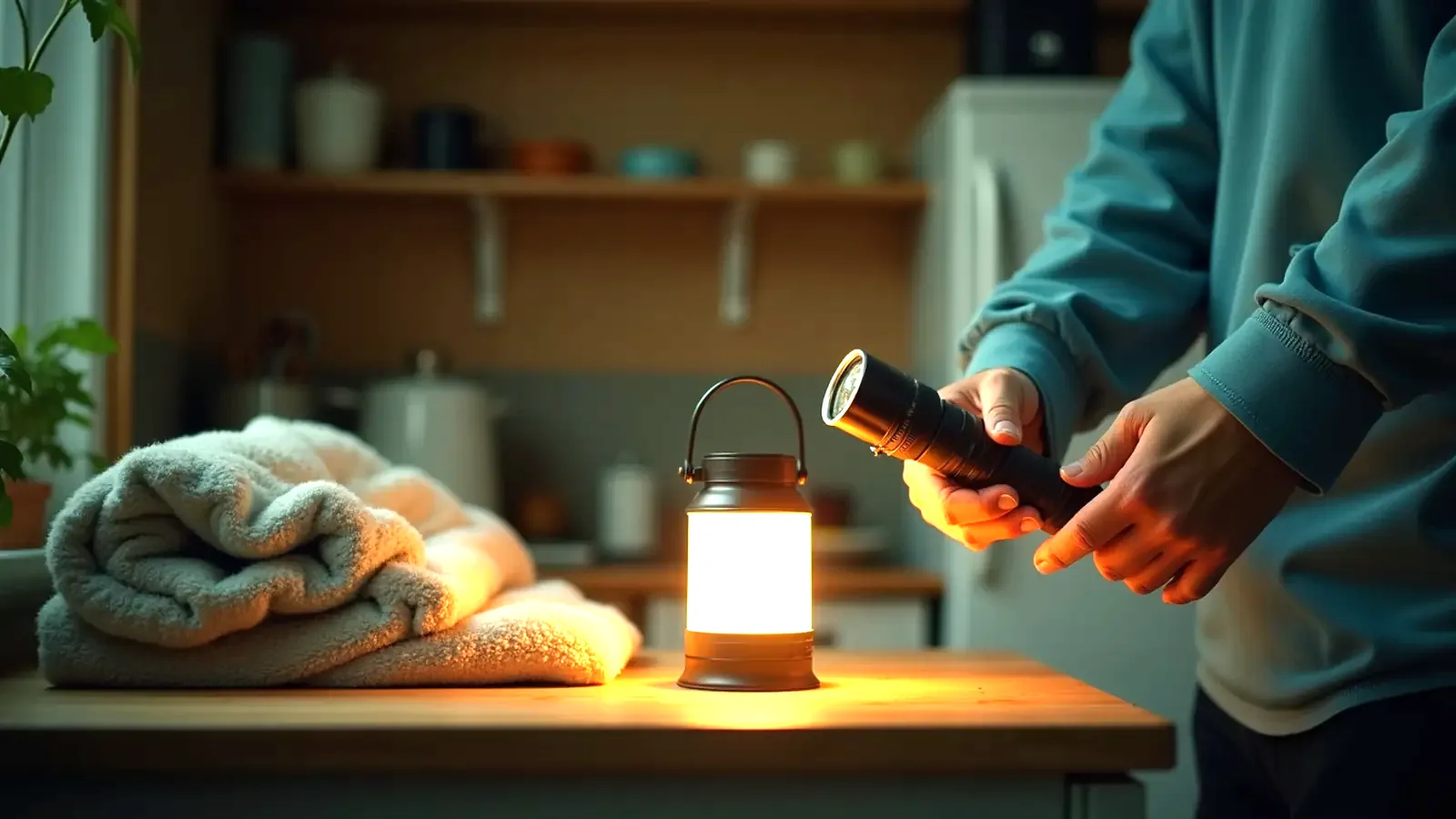
- Use flashlights, not candles (Red Cross). If you must use candles, Tufts advises safe holders away from anything that can burn, never left unattended.
- Unplug appliances and electronics. Power may return with surges or spikes that cause damage (Ready.gov).
- Monitor alerts and follow instructions from local officials (Red Cross, Tufts).
- Check in with your support network and on neighbors, especially older adults and people who live alone (Red Cross, Tufts).
- Turn off utilities only if you suspect damage or officials tell you to. The Red Cross notes a gas line can only be turned back on by a qualified professional.
- Decide whether to stay or go. The Red Cross says to leave if your home is too hot or too cold, or if you have medical devices that need power.
Carbon monoxide: the rule that matters most
Generators go outdoors only, at least 20 feet from windows, doors and attached garages; camp stoves and charcoal grills go outdoors only, at least 20 feet from windows (Ready.gov). The Red Cross says never use them inside a home, garage, basement, crawlspace or any partly enclosed area, and that opening doors and windows or using fans will not prevent carbon monoxide buildup. Never heat your home with a gas stove or oven (Ready.gov). If a CO alarm sounds, or anyone feels dizzy, weak or sick, get outside to fresh air and call for help from there (Red Cross).
If you use a generator, the Red Cross adds: keep it dry, let it cool before refueling, plug appliances in with heavy-duty outdoor-rated cords, and never plug it into a wall outlet. That "backfeeding" can electrocute utility workers and neighbors; a permanent connection needs a transfer switch installed by an electrician.
A no-cook meal plan for outage days
The Red Cross says to eat your fresh, perishable food first and to avoid opening the refrigerator and freezer, so decide what you need before you open the door, take out only that, and close it right away. If the outage is running long, move the rest into a cooler with ice (Ready.gov). Ready.gov notes that commercially canned food can be eaten right out of the can, so none of the meals below needs the stove.
| Day | Breakfast | Lunch | Dinner | Snacks |
|---|---|---|---|---|
| Day 1 (fridge food first) | Yogurt and fresh fruit, or cereal with the open milk | Sandwiches from deli meat and cheese, eaten in one fridge trip | Leftovers that are still cold, or canned soup eaten cold | Whole fruit, crackers |
| Day 2 (pantry) | Dry cereal with shelf-stable boxed milk | Peanut butter on crackers, applesauce cups | Canned chicken or tuna with crackers, canned fruit | Granola bars, dried fruit |
| Day 3 (pantry) | Granola with shelf-stable milk, juice box | Canned ravioli or chili straight from the can | Canned stew, canned vegetables | Pretzels, nuts if no allergies |
Keep a manual can opener with the food (Ready.gov).
One optional way to cook: an outdoor camp stove
Every meal above is no-cook. If your family wants one hot meal a day, a camp stove or a charcoal grill you already own, used outdoors, is the simplest add-on. Ready.gov says camp stoves and charcoal grills are for outdoor use only, at least 20 feet from windows, and the Red Cross says never in a garage, basement or any partly enclosed area. The CDC says never use a portable gas camp stove indoors. Use it only where you have a safe outdoor spot, follow the maker's instructions, and store the fuel outside living areas, as the Red Cross advises for generator fuel. To heat food in the can, Ready.gov says to remove the label, thoroughly wash and disinfect the can, and open it before heating.
When the outage runs past 4 hours, the guide to how long food is good in the fridge without power has the keep-or-toss charts. Ready.gov's rule: throw out food that has been at 40 °F or higher for two hours or more, or that has an unusual odor, color or texture. Never taste food to check it.
Staying warm or cool safely
- Seal around windows to insulate your home (Red Cross), and close off rooms you aren't using.
- Never use a gas stove or oven to heat your home (Ready.gov), and never bring outdoor heaters or stoves inside (Red Cross).
- If heat or cold is extreme, go to a community location with power (Ready.gov). Check with local officials about warming and cooling centers; the Red Cross notes communities often provide them, along with charging stations.
Medical devices and refrigerated medicines
This site does not give medical advice; make this plan with whoever prescribes the device or medicine. Ready.gov says to talk to your medical provider about a power outage plan for powered medical devices and refrigerated medicines, and to find out how long medication can be stored at higher temperatures. You can also ask your utility what it offers customers who rely on powered medical equipment.
During an outage, Tufts emergency management says to call 911 if you depend on equipment that needs electricity and need medical help. After the power returns, Ready.gov's general rule is that if it was out for more than a day, refrigerated medication should be discarded unless the label says otherwise; consult your doctor or pharmacist right away for a new supply.
Water, wells and flushing toilets
Virginia Tech Extension notes that a power outage can leave well pumps unable to work. Tufts emergency management advises filling the bathtub and spare containers before an outage if your water comes from a well pump, and using bathtub water for sanitation only, such as flushing and washing, not drinking. Drinking water comes from your stored supply.
Ready.gov notes that an outage can also disrupt water service and cause water contamination, so listen for instructions from local officials about your water.

After the power comes back
Stay away from downed lines
Stay at least 35 feet from fallen power lines and anything touching them, and call 911 (Red Cross). Tufts adds: always assume a downed line is live, and keep children and pets away.
Done when: everyone is 35 feet away and 911 is called.
Check the food
Use the fridge thermometer and the keep-or-toss charts. When in doubt, throw it out (Ready.gov, Red Cross).
Done when: every item is checked and doubtful food is thrown out.
Plug things back in slowly
Reconnect appliances and electronics once power is steady. If circuit breakers tripped, the Red Cross says to contact an electrician to inspect them before turning them on.
Done when: appliances are back on and any tripped breaker has been inspected.
Avoid flood-damaged electrics
Don't use electrical equipment that may have been underwater; have a qualified electrical inspector check the system (Red Cross).
Done when: nothing that was underwater is used until an inspector checks it.
Restock
Recharge power banks and add anything you lacked to your kit.
Done when: power banks are charged and kit gaps are on your list.
An evening outage, start to finish
A winter storm takes the power out at 5 p.m. in a home with an electric stove and a well. The parents hand out flashlights, unplug the TV and computer, and fill the bathtub from what is left in the pipes. Dinner is the open deli meat and cheese from one quick fridge trip, plus crackers and canned fruit. The family sleeps in one room under extra blankets. By morning the house is cold and the utility says the repair will take another day, so they pack the cooler food, the stored water and their medicines and go to a warming center the county has opened.
Troubleshooting
- If your phone is running low
- Lower the screen brightness, close apps and charge from a power bank. If you charge in the car, park outside: the CDC says never run a car in a garage attached to the house, even with the door open.
- If only your home is dark
- Report the outage to your utility, and have an electrician inspect any tripped breakers before turning them on (Red Cross).
When to get help
Call for help if
- A carbon monoxide alarm sounds, or anyone feels sick, dizzy or weak: get to fresh air first, then call for help from there (Red Cross).
- You see a downed power line: stay 35 feet away and call 911 (Red Cross).
- Someone depends on powered medical equipment and needs help: call 911 (Tufts emergency management).
- Your home becomes too hot or too cold to stay in: ask local officials about heating or cooling centers.
Who to ask. In an emergency, call 911. If a carbon monoxide alarm sounds or anyone feels dizzy, sick or confused, get everyone outside into fresh air first, then call 911. Report outages and downed power lines to your utility. For local hazards, shelters and alerts, contact your city or county emergency management office (start at Ready.gov).
Frequently asked questions
Do I need to unplug everything during a power outage?
Unplug appliances, equipment and electronics, especially sensitive ones like TVs and computers. Ready.gov says power may return with momentary surges or spikes that cause damage, and the Red Cross says unplugging prevents overloads. Leave the fridge and freezer closed; you can plug things back in once power is steady.
Can I flush the toilet when the power is out?
It depends on whether water still reaches your home. On a well with an electric pump, the pump stops with the power (Virginia Tech Extension), so fill the bathtub before an outage and use that water for flushing and washing, not drinking, as Tufts emergency management advises. On city water, listen for instructions from local officials.
How do you live with no power for a few days?
Keep the fridge closed and eat no-cook pantry food, use flashlights, unplug electronics, keep fuel-burning devices outdoors and follow news by battery radio. The Red Cross suggests two weeks of food and water at home, and leaving for a warming or cooling center if your home gets too hot or cold.
Is it safe to use a camp stove or grill during an outage?
Only outdoors. Ready.gov says camp stoves and charcoal grills should always be used outside, at least 20 feet from windows. The CDC says never burn charcoal or use a portable camp stove indoors. Install battery-backup carbon monoxide alarms inside.
Sources
- Power Outages, Ready.gov, FEMA (accessed October 28, 2026).
- Food, Ready.gov, FEMA (accessed October 28, 2026).
- Power Outage Safety, American Red Cross (accessed October 28, 2026).
- Generator Safety, American Red Cross (accessed October 28, 2026).
- Carbon Monoxide (CO) Poisoning Basics, Centers for Disease Control and Prevention (accessed October 28, 2026).
- Power Outage Tips, Tufts University Office of Emergency Management, republishing the Massachusetts Emergency Management Agency (accessed October 28, 2026).
- Emergency Supplies of Water for Drinking and Food Preparation, Virginia Cooperative Extension, Virginia Tech (accessed October 28, 2026).
Ready for the next outage
Before, during and after an outage, in order: food safety, light, water, staying warm or cool, and generator safety.