
Power Outages
How long is food good in the fridge without power? The 4-hour rule and a keep-or-toss chart
Keep the doors shut, note the time and check the temperature. This page gives the official time limits and a food-by-food chart so you can decide in minutes what to keep, cook or throw out.
On this page (12 sections)
- How long food stays safe in the fridge and freezer without power
- How to decide what to keep, step by step
- Refrigerator chart: keep or throw out
- Freezer chart: refreeze or throw out
- How to keep food cold longer without a generator
- A 36-hour winter outage, sorted
- Medicines that need refrigeration
- Troubleshooting
- When to get help
- Frequently asked questions
- Next in the manual
- Sources
If the power is out and you are standing at the fridge wondering how long food is good in the fridge without power, and whether the chicken and milk are still safe, the answer depends on time and temperature. Food in the fridge is good for about 4 hours without power if the door stays closed; a full freezer holds for about 48 hours, and a half-full one about 24 hours, according to the CDC and FDA.
After that, the line is 40 °F (4 °C): the CDC and FDA say the fridge should be at 40 °F or below. Perishable food that has been above 40 °F for 2 hours or more should be thrown out (Ready.gov). If you threw away a whole fridge of food last time because you couldn't tell, you were not overreacting: without a temperature reading, that is the safe call. The charts below, based on the Penn State and University of Delaware Extension keep-or-discard lists, let you sort the fridge item by item next time, so you keep what is safe and only toss what isn't.
Key takeaways
- Fridge: about 4 hours with the door shut. Full freezer: about 48 hours; half-full: about 24 (CDC, FDA).
- Keep appliance thermometers in the fridge and freezer: they turn guessing into a reading (FDA, CDC).
- Toss perishables such as meat, poultry, fish, milk, soft cheese, eggs and leftovers after 2 hours above 40 °F (Ready.gov, Penn State Extension).
- Frozen food that still has ice crystals or is at 40 °F or below can be refrozen or cooked (CDC, FDA).
- Never taste food to check it. When in doubt, throw it out (CDC).
- Generators stay outdoors, at least 20 feet from windows, doors and attached garages (Ready.gov), never in a home, garage or basement (American Red Cross).
The power just went out: do this now
- Note the time the power went off. Every decision below starts from it.
- Keep the fridge and freezer doors shut. Eat from the pantry instead.
- If the outage may pass 4 hours, line up a cooler and ice or frozen gel packs (CDC, FDA).
How long food stays safe in the fridge and freezer without power
| Appliance | Safe for about | Then |
|---|---|---|
| Refrigerator | 4 hours | Move perishables to a cooler with ice, or check temperatures and use the chart below |
| Full freezer | 48 hours | Check each package for ice crystals or 40 °F or below |
| Half-full freezer | 24 hours | Same check, sooner |
The University of Delaware Extension explains why these are estimates: how long food stays cold depends on how cold the fridge was, how warm the room is and how often the door is opened. Its fact sheet gives 4 to 6 hours for the fridge; plan on 4 to be safe. A full freezer of meat stays colder than a freezer full of baked goods, and a larger freezer holds longer.
Bacteria grow rapidly between 40 and 140 °F (4 to 60 °C), which Ready.gov calls the reason food becomes unsafe without a cold source. Penn State Extension calls this range the "temperature danger zone."
How to decide what to keep, step by step
Work out how long the power was off
Under 4 hours with the doors shut: refrigerated food should be safe (CDC, FDA). Longer: go to step 2.
Done when: you know roughly how many hours the power was off.
Read the appliance thermometer
The FDA says to keep appliance thermometers in both units: the fridge at or below 40 °F, the freezer at or below 0 °F (-18 °C). If the fridge still reads 40 °F or below, the food is fine. If the freezer reads 40 °F or below, the FDA says the food is safe and may be refrozen.
Done when: you have written down both thermometer readings.
No thermometer? Check each item
The FDA says you can't rely on appearance or odor. Use a food thermometer on individual items, and check frozen packages for ice crystals.
Done when: every item has a temperature reading or an ice-crystal check.
Sort with the charts below
Perishables above 40 °F for 2 hours or more go out (Ready.gov, Penn State Extension). Many condiments, hard cheeses, butter, bread and whole fruit are safe longer (Penn State, University of Delaware Extension).
Done when: every item is in a keep pile or thrown out.
Cook or refreeze what you keep
Frozen food with ice crystals, or at 40 °F or below, can be refrozen or cooked (CDC, FDA). If you eat meat, poultry, fish or eggs that stayed cold, the FDA says to cook each item to its safe minimum internal temperature.
Done when: kept frozen food is back in the freezer or cooked.
Refrigerator chart: keep or throw out
For food that has been above 40 °F for more than 2 hours. Food that stayed at 40 °F or below is fine. Based on the University of Delaware and Penn State Extension lists.
| Food | Keep or throw out |
|---|---|
| Raw or cooked meat, poultry, fish and seafood; lunch meat, hot dogs, bacon; meat-topped pizza | Throw out |
| Milk, cream, sour cream, yogurt; soft cheeses, cottage cheese, shredded and low-fat cheeses | Throw out |
| Fresh eggs, egg dishes, custards and puddings | Throw out |
| Casseroles, soups, stews, leftovers; cooked pasta, rice and pasta salads | Throw out |
| Opened baby formula | Throw out |
| Cut fresh fruit; cooked vegetables; opened vegetable juice; baked potatoes | Throw out |
| Refrigerator biscuits, rolls and cookie dough; cream-filled pastries; custard or cheese pies | Throw out |
| Hard and processed cheeses, grated Parmesan | Keep |
| Butter and margarine | Keep |
| Whole fresh fruit and vegetables; opened fruit juice; opened canned fruit; dried fruit | Keep |
| Bread, rolls, cakes, muffins; fruit pies | Keep |
| Peanut butter, jelly, relish, mustard, ketchup, olives; taco, barbecue and soy sauces | Keep |
| Opened mayonnaise, tartar sauce, horseradish | Throw out if above 50 °F for more than 8 hours (Penn State Extension) |
Throw out anything that has an unusual odor, color or texture, even if the chart says keep (CDC). An odd smell means toss it; a normal smell does not prove it is safe.
Freezer chart: refreeze or throw out
The CDC and FDA rule: thawed food that still contains ice crystals, or is at 40 °F or below, can be safely refrozen or cooked. The University of Delaware chart adds detail for food that thawed and sat above 40 °F for over 2 hours:
| Food | Still has ice crystals or at 40 °F or below | Thawed, above 40 °F over 2 hours |
|---|---|---|
| Beef, pork, ground meat, poultry | Refreeze | Throw out |
| Fish and shellfish | Refreeze (some texture loss) | Throw out |
| Casseroles, stews, soups, pizza | Refreeze | Throw out |
| Ice cream, frozen yogurt | Throw out if melted | Throw out |
| Hard cheeses | Refreeze | Refreeze |
| Fruit juices and fruit | Refreeze (texture may change) | Refreeze; throw out if moldy or slimy |
| Vegetables | Refreeze (texture will change) | Throw out |
| Bread, rolls, plain cakes, pie crusts | Refreeze | Refreeze |
Delaware Extension also says to throw out any food that raw meat, poultry or fish juices have dripped onto, and to mark refrozen packages so you know to check them before cooking.
How to keep food cold longer without a generator
- Keep doors closed. Delaware Extension calls it the most important step for the freezer.
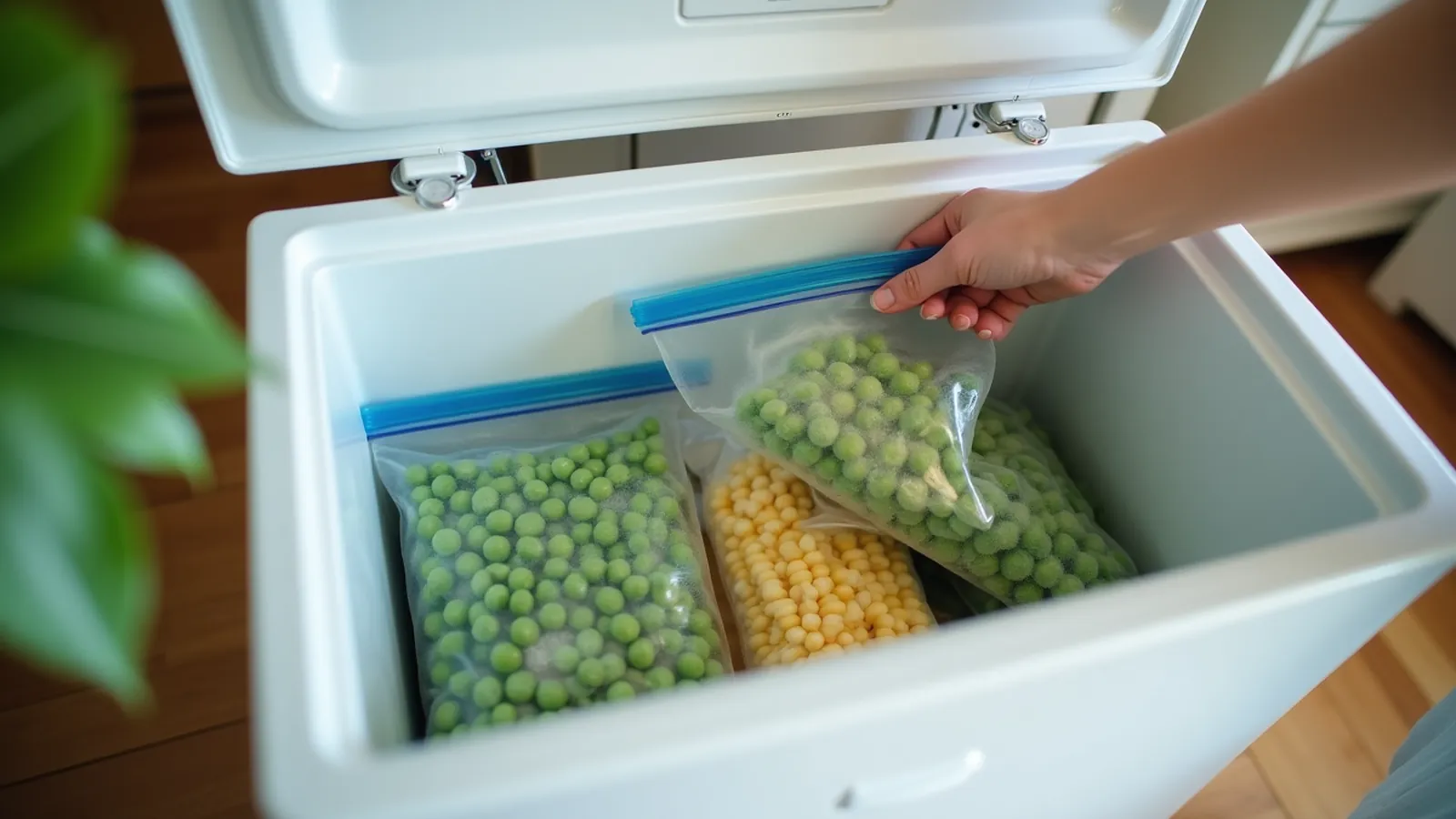
- Freeze water ahead of time. Containers of frozen water and gel packs help keep food cold, and the melting ice gives you drinking water (FDA, CDC). See the emergency water storage guide.
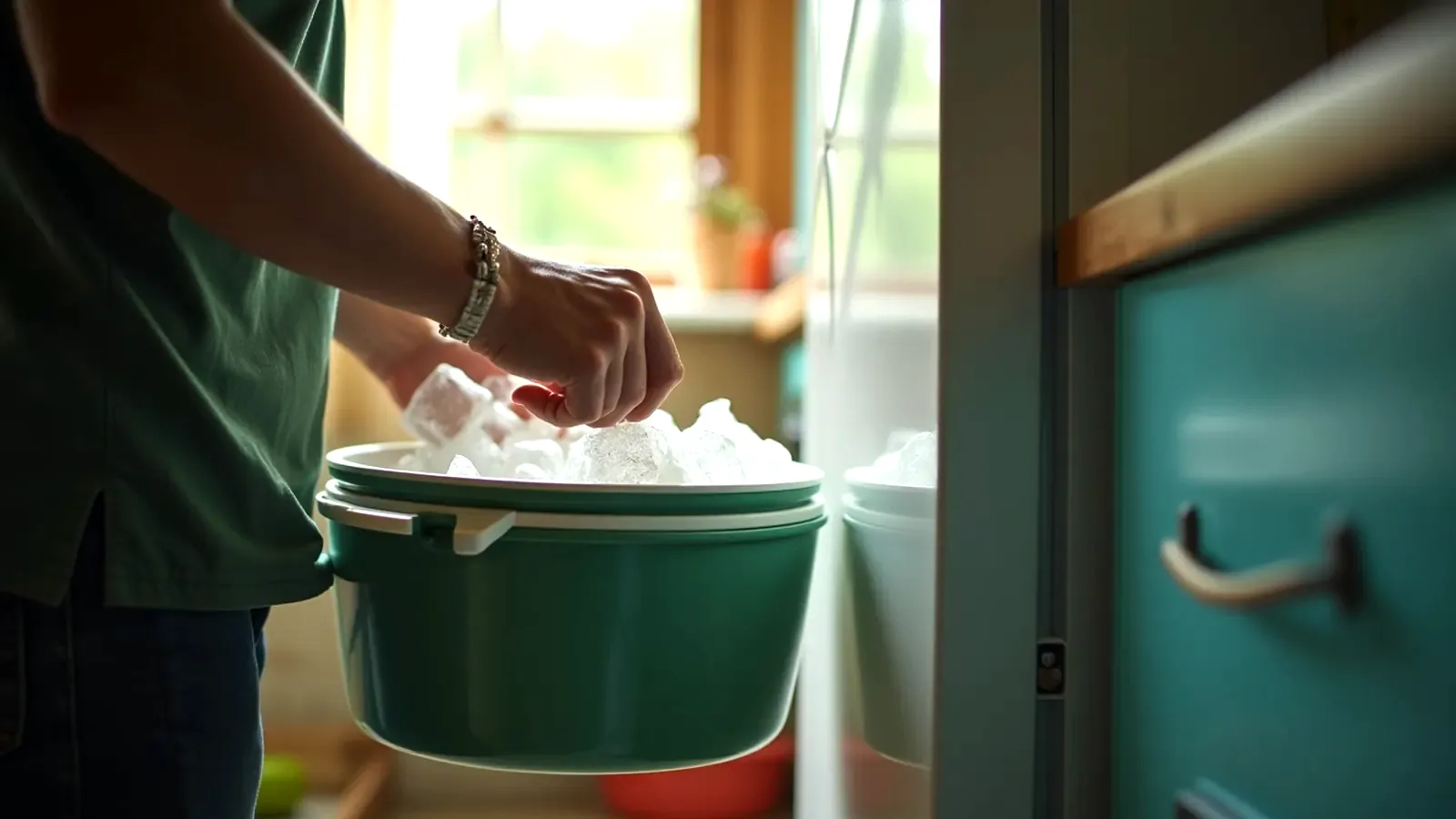
- Use a cooler after 4 hours. If the power has been out 4 hours, the CDC says to move refrigerated perishables to a cooler with ice or frozen gel packs to keep them at 40 °F or below.
- Block ice in the fridge. Delaware Extension says a block of ice on a pan in the fridge helps keep the temperature low.
- Dry ice for a long outage. Figures vary by source: the FDA says 50 pounds should keep a fully stocked 18-cubic-foot freezer cold for two days; Ready.gov says 25 pounds keeps a 10-cubic-foot freezer below freezing for 3 to 4 days. Wear dry, heavy gloves, keep it off food (Ready.gov), and keep the room ventilated (Delaware Extension).
- Insulate the freezer. A blanket over the freezer helps, as long as it doesn't block the air vent (Delaware Extension).
Keep an appliance thermometer in both the fridge and the freezer so you can read the temperature instead of guessing (FDA, CDC). They are a small, one-time purchase that makes every later outage easier. If you need them: appliance thermometers (Amazon, affiliate link) opens in a new tab for the fridge and freezer, and food thermometers (Amazon, affiliate link) opens in a new tab for checking individual items.
Watch for: generators and carbon monoxide
If you run a generator for the fridge, the American Red Cross says never use it inside a home, garage, basement, crawlspace or any partly enclosed area; opening doors and windows will not prevent carbon monoxide buildup. Ready.gov says to keep it at least 20 feet from windows, doors and attached garages and to install carbon monoxide detectors with battery backup. Never plug a generator into a wall outlet: the Red Cross says this "backfeeding" puts utility workers and your household at risk, and a permanent connection needs a transfer switch installed by an electrician.
A 36-hour winter outage, sorted
The power goes out at 6 p.m. The household keeps both doors shut and eats from the pantry. At 10 p.m. the fridge thermometer reads 41 °F, so the milk, chicken, yogurt and leftovers go into a cooler packed with frozen water bottles from the freezer. The next evening, 24 hours in, the cooler still reads 40 °F. When the power returns at 6 a.m. the following day, the cooler food is used first. The freezer was full, and at about 36 hours most packages still have ice crystals, so they are refrozen. One package of fish has fully thawed and reads 45 °F; it goes out. The butter, ketchup, hard cheese and bread stayed in the fridge and are kept.
Medicines that need refrigeration
This site does not give medical advice, and medicines are not food: ask before you decide. Ready.gov's general rule is that if the power is out for more than a day, you should discard medication that should be refrigerated unless the drug's label says otherwise, and consult your doctor or pharmacist right away for a new supply. The FDA says to check the medicine's storage instructions or contact a pharmacist, health care provider or the manufacturer, and notes that if a life-sustaining medicine such as insulin has no replacement readily available, it may be used until you get a new supply. Plan ahead with your provider, and keep a cooler and frozen gel packs ready (FDA).
Troubleshooting
- If you don't know how long the power was off
- Check the time on a stopped clock or your utility's outage report. If you still can't tell and have no thermometer reading, throw perishables out (CDC).
- If the freezer food is soft but still cold
- Check it with a food thermometer: at 40 °F or below, refreeze or cook it (FDA).
- If the fridge reads 42 °F after 3 hours
- Move the perishables to a cooler with ice now; the clock on food above 40 °F has started.
- If food touched floodwater
- Throw it out, along with food in containers that aren't waterproof (CDC).
When to get help
Call for help if
- Anyone has vomiting, diarrhea, stomach pain or flu-like symptoms after eating questionable food: contact a health care provider (FDA).
- A refrigerated medicine got warm: call a pharmacist or the prescriber before using or discarding it.
- A carbon monoxide alarm sounds or anyone feels dizzy near a generator: get outside, then call 911.
Who to ask. In an emergency, call 911. If a carbon monoxide alarm sounds or anyone feels dizzy, sick or confused, get everyone outside into fresh air first, then call 911. Report outages and downed power lines to your utility. For local hazards, shelters and alerts, contact your city or county emergency management office (start at Ready.gov).
Frequently asked questions
How long does it take for food to spoil when the power is out?
With the doors kept closed, the CDC and FDA say fridge food stays safe for about 4 hours, a full freezer for about 48 hours and a half-full freezer for about 24 hours. After that, the temperature decides: perishable food that has been above 40 °F for 2 hours or more should be thrown out (Ready.gov).
What food should I throw away after a power outage?
Meat, poultry, seafood, milk, soft cheeses, eggs, leftovers, cut fruit and cooked pasta or rice that have been above 40 °F for more than 2 hours (Penn State and University of Delaware Extension), plus any food with an unusual odor, color or texture (CDC). Hard cheese, butter, bread, whole fruit and most condiments can usually be kept.
How long does milk last in a refrigerator without power?
Milk follows the 4-hour rule: if the door stayed shut and the power was out 4 hours or less, it should be safe (CDC). Penn State and Delaware Extension list milk as a food to throw out once it has been above 40 °F for more than 2 hours. Move it to a cooler with ice if the outage is going long.
How long do eggs last in the fridge without power?
Fresh eggs are on the throw-out list once they have been above 40 °F for more than 2 hours, according to Penn State and University of Delaware Extension. Within 4 hours of a closed-door outage they should still be fine (CDC). Put them in the cooler early if the power will be out longer.
Sources
- Keep Food Safe After a Disaster or Emergency, Centers for Disease Control and Prevention (accessed October 28, 2026).
- Food and Water Safety During Power Outages and Floods, U.S. Food and Drug Administration (accessed October 28, 2026).
- Food, Ready.gov, FEMA (accessed October 28, 2026).
- Power Outages, Ready.gov, FEMA (accessed October 28, 2026).
- Keeping Food Safe When the Power Goes Out!, Penn State Extension (accessed October 28, 2026).
- When the Power is Out, University of Delaware Cooperative Extension (accessed October 28, 2026).
- Safe Drug Use After a Natural Disaster, U.S. Food and Drug Administration (accessed October 28, 2026).
- Generator Safety, American Red Cross (accessed October 28, 2026).
Ready for the next outage
Before, during and after an outage, in order: food safety, light, water, staying warm or cool, and generator safety.