
Food & Water
Expired canned food: what's still safe and what to toss
Most dates on a can are freshness estimates, not safety deadlines — and the can's condition matters more than the number printed on it. Here is what the labels mean, a 30-second inspection, and a first-in-first-out habit that stops the shelf from becoming a graveyard.
On this page (12 sections)
- Best by vs. use by: what the date on a can means
- Is expired canned food safe to eat?
- Home-canned jars are a different question
- Dented canned food safety and the 30-second can check
- A shelf-life table by food type, without invented dates
- First in, first out: the labeling habit that ends the graveyard
- The budget angle: stop paying for food twice
- If something goes wrong
- When to get help
- Frequently asked questions
- Keep going
- Sources
Your emergency food shelf has become a graveyard of expired canned food — dusty lids, dates from two winters ago, crackers gone soft — and you've thrown away more than that shelf ever saved you. You built it to be ready for an outage and to spend less, and instead you bought the same cans again this fall.
Here is the fix, without a bigger pantry or an app you'll abandon by February: what the date on a can actually means, a 30-second inspection before you open anything, and a first-in-first-out habit built on a marker, a "use first" basket and a quarterly reminder. Nothing on this page is for sale, and the checklist below is the useful part.
Key takeaways
- Most dates on a can are quality dates. They describe peak flavor, not whether the can in your hand is safe.
- The can's condition and storage history decide what you do with it: bulging ends, a leak, a deep dent or rust that pits the metal mean discard, whatever the date says.
- You cannot smell or taste botulism toxin. An off odor can only condemn a can, never clear one, so never taste a suspect can to check it.
- Rotation beats stockpiling: date every can the day it comes home, load new cans behind old ones, and run a short check four times a year.
Best by vs. use by: what the date on a can means
Treat the words on the lid as freshness estimates from the maker, not a safety test. A can with no date is normal for many foods; a can with a date has been labeled for flavor and quality. Neither tells you whether the seal has failed or whether the can spent a summer in a hot garage.
| What you see | What it tells you | Your move |
|---|---|---|
| "Best if used by" or "Best by" | The maker's estimate of best flavor and quality | Eat it. Expect softer vegetables or a flatter flavor, not spoilage |
| "Use by" | The last date for peak quality as the maker defines it | On a shelf-stable can, treat it like a best-by date — then inspect the can |
| "Sell by" | A message to the store about display and inventory | Ignore it once the can is in your cupboard |
| A stamped code of letters and numbers | A packing lot and date code, not a consumer expiration date | Write your own purchase month and year on the can so its age is knowable |
| No date printed anywhere | Normal for many canned foods | Date it yourself when it comes home; that is the date that helps you rotate |
One habit makes every row easier: keep a marker in the drawer next to the can opener. Write the month and year you bought the can on the top of the lid in big numbers. Thirty seconds at the grocery bag saves you the guessing game two years later.
Is expired canned food safe to eat?
Usually yes, if the can is intact and has been stored somewhere cool and dry. "Expired" on a can of beans means past the point of best quality, and quality is what declines first: vegetables soften, tomato products darken, flavors go flat, and fruit in syrup may look paler than you remember.
What makes canned food unsafe is not the calendar. It is a failed seal, damage to the can, or storage conditions that let the contents spoil — heat, damp, rust working at the seams. USDA FSIS shelf-stable food guidance puts badly dented and badly rusted cans in the discard pile for that reason: the container has stopped doing its job.
Storage temperature is the part most households get wrong, because the garage and the shed are convenient. The National Center for Home Food Preservation's rule for canned food is below 95 °F [35 °C], with 50 to 70 °F [10 to 21 °C] best for quality. Above that, food loses quality in weeks or months rather than years.
One thing worth saying plainly: you cannot smell or taste botulism toxin, and the spoilage organisms that do smell are not the same ones that make low-acid canned food dangerous. That is why an off odor can only condemn a can, never clear one.
A can past its date, in order
Run the outside inspection below first — it takes half a minute. If the can passes (no bulge, no leak, no deep dent, no pitted rust, stored cool and dry), cook it into a meal this week rather than saving it for a special occasion. You are judging the container and its history, not its smell. If it fails any check, it goes out.
Home-canned jars are a different question
Everything above is about commercially canned food, sealed in a factory. Jars you canned yourself follow stricter rules, because a low-acid food that was not processed correctly can look, smell and taste normal and still be unsafe.
NCHFP explains why plainly. Bacteria that grow in low-acid food without air can multiply and produce a deadly toxin within 3 to 4 days in a moist, low-acid environment between 40 and 120 °F [4 and 49 °C] — which describes the inside of a sealed jar. Low-acid foods have a pH above 4.6: vegetables, meat, poultry, seafood, milk and mixtures of those with acid foods. Destroying those spores takes 240 to 250 °F [116 to 121 °C], a temperature only a pressure canner reaches, held for 20 to 100 minutes depending on the food, the pack and the jar size. A boiling-water canner would need 7 to 11 hours for the same job, which is why boiling water is not the method for low-acid food.
So a home-canned jar's safety rests on four things, and none of them is the date: a research-tested recipe, the right method for that food's acidity, the full processing time, and the pressure or time adjusted for your altitude. NCHFP says not to taste food from a jar with an unsealed lid or one showing signs of spoilage. If you don't know how a jar was processed, it isn't worth opening.
Why you can check the canning advice yourself
Every canning method on this site follows tested USDA and National Center for Home Food Preservation recipes — pressure canning for low-acid foods, at the pressures and times those sources publish, adjusted for altitude. Nothing here recommends oven canning, open-kettle processing, inversion seals, dishwasher canning, paraffin seals or other untested shortcuts, and each page lists its sources so you can open the primary documents yourself. We don't name a "best" canner, because we haven't bought or tested one. Gear pages on the site explain what to look for and link to a labeled Amazon search; the site's only other labeled affiliate link lives on a review page. No food-safety professional reviews these guides, as how we write explains.
If you're new to it, start with pressure canning for beginners, which walks through the method and the altitude adjustment before the first jar.
Dented canned food safety and the 30-second can check
This check decides more than any date does. Run it in the store, in the pantry, and again before you open a can you're unsure about.
| What you see | What it means | What to do |
|---|---|---|
| A bulging end, or a can that rocks on a flat counter | Something inside is producing gas; the seal has failed or the contents are spoiled | Discard without opening. Keep it away from pets |
| A deep dent you can lay a finger into, or any dent on a seam or rim | The seal may be compromised even if it looks fine | Discard. FSIS puts badly dented cans in the discard pile |
| Rust that pits the metal, or rust along a seam | The can wall or seal is being eaten away | Discard. Light surface rust on a dry label is a judgment call — pitting is not |
| A sticky patch, a stain, or a can that smells of the food on the outside | The can is leaking or has leaked | Discard, and check the cans stored around it |
| Liquid spurts or foams when you open it, or the contents bubble | Pressure built up inside — a spoilage signal | Discard. Wash the opener and your hands afterward |
| Cloudy liquid or contents that look slimy | Spoilage has started | Discard. Do not taste to confirm |
- The can is not bulging and does not rock when you set it on the counter.
- There is no dent on a seam or rim, and no dent deep enough to catch your finger.
- There is no rust that pits the metal or reaches a seam.
- The outside is clean and dry — no sticky film, no stain, no smell of food.
- The can is stored below 95 °F, off a concrete floor, out of sunlight.
- When you open it, nothing spurts, foams or bubbles.
- You are not relying on taste to make the decision — when in doubt, it goes out.
A shelf-life table by food type, without invented dates
You'll find plenty of charts online promising exact windows — tomatoes 18 months, tuna five years. We won't print year counts we can't source, and the honest answer is that the number depends on the can, the food, the storage temperature and how the can has been handled. What follows is what fades first in each kind of canned food, so you know what to check and which cans to eat first.
| Food type | What fades first | Check before you use it | Rotation note |
|---|---|---|---|
| High-acid: tomatoes, fruit, pickles, citrus, juice, vinegar-based foods | Color and bright flavor | No bulging, no seam rust, no pinholes near the rim | Eat these first — acid foods lose their brightness soonest |
| Low-acid: beans, corn, peas, carrots, soup, broth, pasta | Texture; vegetables go soft and starch turns mushy | No bulge, no leak, no spurting on opening | Keep them cool and dark; these are your meal-base cans |
| Meat, poultry and canned fish | Texture and flavor; fat can go rancid over long storage | No bulge, no cloudy liquid, no leaking seam | Often the most expensive cans on the shelf — date them at purchase |
One practical anchor from NCHFP: can no more food than you will use within a year. That is a better rule than any shelf-life chart, because it plans for eating rather than for storing.
First in, first out: the labeling habit that ends the graveyard
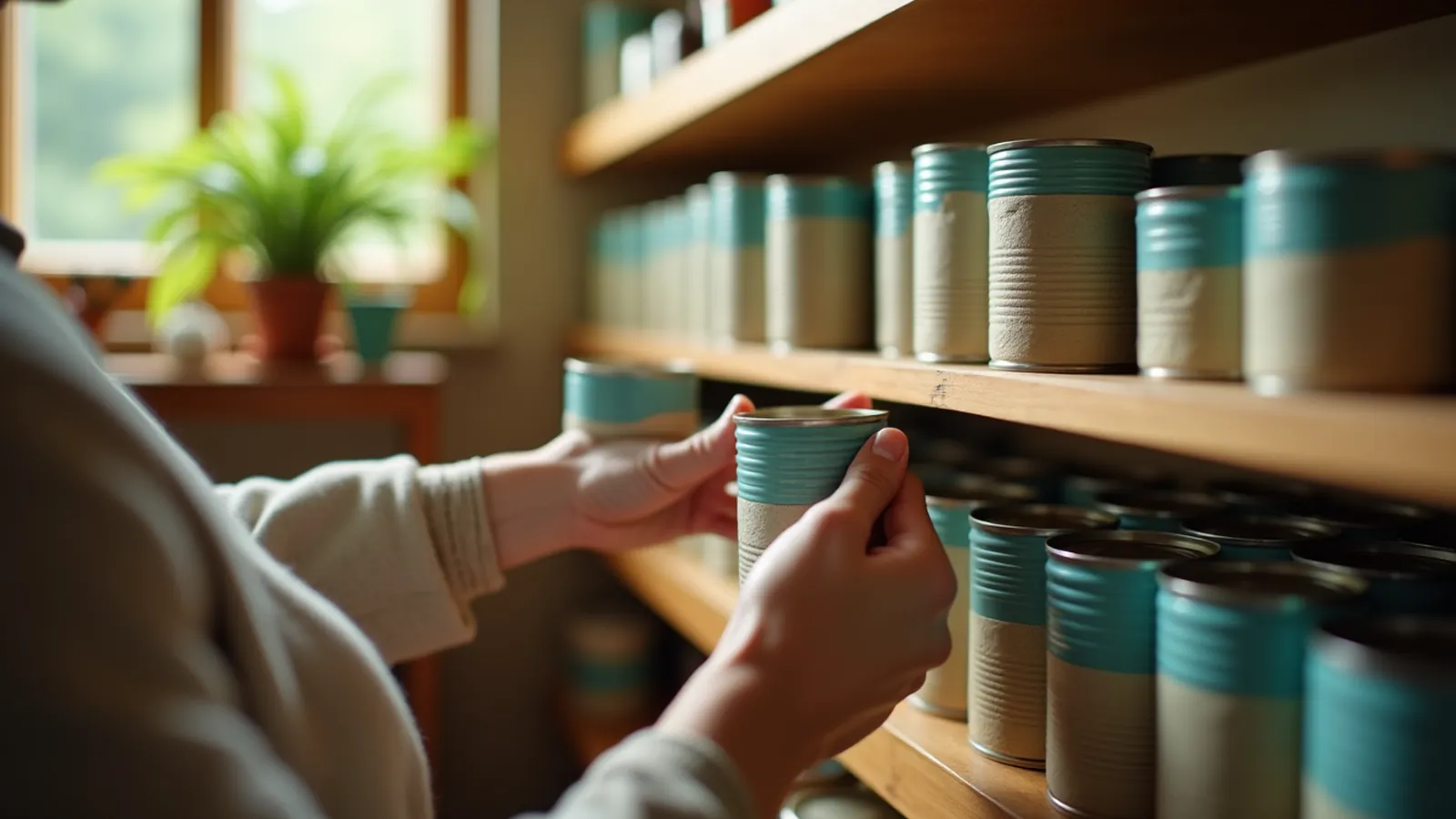
Food expires on a shelf for one reason: the oldest can sits at the back where you can't see it, and the new cans sit at the front where you can. A few minutes of system fixing ends that.
Date every can the day it comes home
Month and year on the lid, written with a marker. A strip of masking tape labeled with the month works the same way and peels off cleanly.
Done when: every can carries a date you wrote.
Load new cans behind old ones
When you put groceries away, new cans go to the back of the row and the older ones slide forward. This one motion is the whole system.
Done when: the front can of every row is the oldest.
Keep a "use first" basket in the kitchen
One small basket in the cupboard where the four or five oldest cans live, out where you'll see them while making dinner. The garage shelf is storage; the basket is a to-do list.
Done when: the basket exists and has cans in it.
Cook one meal a week from the shelf
A can of beans into chili, a can of fruit into muffins, a jar of tomatoes into soup. This keeps the stock moving and shows you which cans your household actually eats.
Done when: one meal a week comes off the emergency shelf.
Put a quarterly reminder on the calendar
Pick the first Saturday of January, April, July and October and run the list below. Fifteen minutes for a two-week supply, once a season.
Done when: all four dates are in the calendar you look at.
The quarterly check, as a list you can work through
- Pull everything off the shelf, wipe the shelf, put it back in date order.
- Set aside any can with a bulge, a leak, a deep dent or rust that pits the metal — straight to the discard pile.
- Move the four oldest cans into the kitchen "use first" basket.
- Count what's left against your two-week plan and write a short shopping list for the gaps.
- Check the storage spot: below 95 °F, dry, off the floor, out of sunlight, nothing heavy stacked on the cans.
- Check that the can opener works and that the marker is still in the drawer.
- Set the next quarterly reminder before you walk away.
If you want the shelves themselves sorted out properly, food storage can rotation goes deeper on layouts for small spaces, and the emergency food supply list helps you decide what deserves a place on the shelf at all. The Food and Water section puts the whole order together.
The budget angle: stop paying for food twice
An unrotated shelf costs you twice — once at the register and once at the bin. The fix isn't buying more; it's buying less of what you won't eat, in sizes you'll actually rotate. Store what your household already cooks with, and the emergency shelf becomes the back half of your regular pantry instead of a separate museum.
A household of four keeping a two-week canned-food supply cleans the shelf once a year and finds eight cans past their best-by date that nobody wants to open. That is most of a week of dinners gone. The same eight cans, bought across a year and eaten in rotation, would have been eight meals — same money, opposite outcome.
Two cheap upgrades do most of the work: a marker for dating lids, and a single shelf where the oldest cans sit at eye level. You do not need a vacuum sealer, an app, or a pallet of food your kids won't eat.
If something goes wrong
- If a can is past its date but passes inspection
- Use it this week in a cooked dish. The date was about quality; the inspection is about the can and its storage history.
- If a can is bulging, leaking or spurting
- Discard it without opening, keep it away from pets, and wash your hands and the can opener afterward.
- If the cans spent the summer in a hot garage
- Move them somewhere below 95 °F and inspect every one. Heat stresses seals, so anything bulging or leaking goes out.
- If the inside of a can is cloudy or slimy once opened
- Throw the contents out and don't taste to confirm. Spoilage signs on the food itself are a discard, not a judgment call.
- If a jar froze over the winter
- Check for splits along the seams and any leaking. NCHFP notes that accidental freezing does not cause spoilage unless a jar becomes unsealed and recontaminated — but a jar you can't vouch for isn't worth opening.
- If you can't remember when you bought any of it
- Start today. Write today's month and year on everything, treat those cans as the oldest, and eat them first over the next few weeks.
- If a home-canned jar lost its seal
- Don't taste it. Discard it, and if you aren't sure the recipe and processing were tested, treat the whole batch as suspect and ask your Cooperative Extension before eating any of it.
When to get help
Call for help if
- Anyone who ate food from a damaged can or a suspect home-canned jar becomes seriously ill: call a health care provider right away, or 911 for severe symptoms. Keep the container and any remaining food for the responders.
- A carbon monoxide alarm sounds while you're cooking on a camp stove or grill during an outage: get everyone outside first, then call 911 from outdoors. Install battery-powered CO alarms on each level of the home and outside sleeping areas. Grills and camp stoves never go indoors — not in a garage with the door open, not in a basement or crawl space — and a generator stays at least 20 feet from doors, windows and vents (CDC).
- You aren't sure whether a batch of home-canned jars was processed with a tested recipe, the right method and the right altitude adjustment: ask your local Cooperative Extension office before anyone eats from it.
- Your water system is under a boil-water notice and you're cooking from storage: follow the notice for the tap water, and see what to boil, bottle and skip.
Who to ask. In an emergency, call 911. If a carbon monoxide alarm sounds or anyone feels dizzy, sick or confused, get everyone outside into fresh air first, then call 911. Report outages and downed power lines to your utility. For local hazards, shelters and alerts, contact your city or county emergency management office (start at Ready.gov).
Frequently asked questions
Is expired canned food safe to eat?
Usually yes, if the can is undamaged and has been stored cool and dry. The date on most cans is a quality date, not a safety deadline. Inspect the can first — no bulging, no deep dents, no pitted rust, no leaks — and remember you cannot smell or taste botulism toxin, so an odd smell can only condemn a can, never clear one.
Is dented canned food safe?
A deep dent you can lay a finger into, or any dent on a seam or rim, goes in the discard pile — FSIS puts badly dented cans there because the seal may be compromised. A small dent in the body away from the seams is your call, and using that can soon is the lower-risk choice. When in doubt, throw it out.
How do I rotate canned food so it doesn't expire?
Date every can the day it comes home, load new cans behind the old ones, and keep the four or five oldest cans in a "use first" basket in the kitchen. Cook one meal a week from the shelf, and run the fifteen-minute check on the first Saturday of each quarter using the list above.
Sources
- Ensuring Safe Canned Foods, National Center for Home Food Preservation (accessed October 30, 2026).
- Storing Home Canned Foods, National Center for Home Food Preservation (accessed October 30, 2026).
- Shelf-Stable Food Safety (PDF), USDA Food Safety and Inspection Service, hosted by Washington State University (accessed October 30, 2026).
- Carbon Monoxide (CO) Poisoning Basics, Centers for Disease Control and Prevention (accessed October 30, 2026).
Food storage, in the right order
The Food and Water section puts buying, storing and rotating food in order, with the supply list and the can rotation system next to this guide.