
Food & Water
Freezing garden vegetables: a chart of blanching times and prep steps
Your garden is outproducing the kitchen and you're not ready to can yet. Here are the tested blanching times for the vegetables you're picking, in one chart, plus the steps that keep them safe and still worth eating in February.
On this page (11 sections)
- Why blanching is the step that decides whether freezing works
- The chart: freezing fresh garden vegetables at the right time
- Freezing vegetables from your garden, step by step
- Thawing and using what you froze
- Where dehydrating fits, and what this chart can't tell you
- Canning and freezing garden vegetables: which to choose this year
- If something goes wrong
- When to get help
- Frequently asked questions
- Keep going
- Sources
It's the middle of the season and the garden has outgrown the kitchen: more green beans than a week of dinners can use, zucchini that got away from you, and a bowl of tomatoes on every flat surface. You're not ready to can — pressure canning low-acid vegetables is its own skill with its own tested times — but you're not willing to watch a summer of work go into the compost either. Freezing garden vegetables is the shortest route from that counter to a shelf of food: blanch it for the time the chart says, cool it, freeze it hard, and it's still good in February.
Below is the chart itself — the blanching time for each common garden vegetable, taken from the National Center for Home Food Preservation — followed by the prep, the packing, the thawing rules, where dehydrating fits, and a plain answer about which vegetables are a freezing job and which are a pressure-canning project. No product picks and no gear list. The numbers are the published, tested ones; the judgment calls are yours.
Key takeaways
- Blanching is the step that decides whether frozen vegetables taste like vegetables. It stops the enzyme action that causes loss of flavor, color and texture, and NCHFP calls it a must for almost all vegetables.
- Underblanching is worse than not blanching at all, and overblanching costs flavor, color, vitamins and minerals. The time matters more than the technique.
- Use one gallon of water per pound of prepared vegetables, and keep batches small enough that the water returns to a boil within one minute.
- Beets, pumpkin and winter squash are cooked, not blanched, before they're frozen.
- Frozen food is safe indefinitely, but it doesn't stay good forever, and it has to thaw safely: in the refrigerator at 40 °F (4 °C) or less, in cold running water under 70 °F (21 °C), or in the microwave if you're cooking it right away.
- Green beans, corn, beets, carrots and squash are pressure-canning vegetables, not water-bath ones. If you're not set up for that yet, freezing is the method to use this season.
Why blanching is the step that decides whether freezing works
Blanching means scalding vegetables in boiling water or steam for a short, specific time, and then getting them cold. The National Center for Home Food Preservation is direct about it: blanching is a must for almost all vegetables to be frozen. It stops enzyme actions that cause loss of flavor, color and texture. It also helps remove dirt and microorganisms, brightens color, slows the loss of vitamins, and wilts or softens the vegetable so it packs more easily.
The part people get wrong is the timing. NCHFP says blanching time is crucial and varies with the vegetable and its size, and that both directions fail. Underblanching stimulates enzyme activity and is worse than no blanching at all. Overblanching causes loss of flavor, color, vitamins and minerals. That's why there is no single "blanch for three minutes" rule that fits a whole garden — a small asparagus stalk and a large ear of corn are not the same job.
If you're freezing vegetables from the garden for the first time, this is the one habit worth building: open the chart before the water goes on, not after.
The chart: freezing fresh garden vegetables at the right time
Prep first. Wash everything, sort out anything bruised or soft, and cut pieces to a consistent size — uniform pieces blanch evenly, and uneven ones leave you with some overdone and some underdone in the same batch. Then set your pot: NCHFP's water blanching method uses one gallon of water per pound of prepared vegetables, with the vegetable in a basket lowered into vigorously boiling water and the lid on. The water should return to boiling within one minute, or you're using too much vegetable for the amount of water.
| Vegetable | Blanching time | What to know |
|---|---|---|
| Asparagus | 2 small stalk, 3 medium, 4 large | Stalk size sets the time, not the bunch |
| Beans: snap, green or wax | 3 | The row that usually overruns you first |
| Beans: lima, butter or pinto | 2 small, 3 medium, 4 large | Same size rule as asparagus |
| Beets | Cook | Cooked rather than blanched |
| Broccoli (flowerets 1½ inches across) | 3 in boiling water, 5 steamed | Steaming takes longer than boiling water for this one |
| Brussels sprouts | 3 small heads, 4 medium, 5 large | Trim the stem end first |
| Cabbage or Chinese cabbage, shredded | 1½ | Shred before blanching |
| Carrots | 5 small whole, 2 diced, sliced or in strips | Cutting it small cuts the time more than half |
| Cauliflower | 3 | Flowerets about 1 inch across |
| Celery | 3 | Cut into the size you'll cook with |
| Corn on the cob | 7 small ears, 9 medium, 11 large | The longest blanch in the chart |
| Corn, whole kernel or cream style | 4 | Blanch the ears first, then cut from the cob |
| Eggplant | 4 | Slice or cube; it darkens quickly once cut |
| Greens | 3 collards, 2 all other greens | Wash grit out before blanching |
| Kohlrabi | 3 whole, 1 cubed | Cube it and save two minutes |
| Mushrooms | 5 whole, 3½ buttons or quarters, 3 slices | Steamed in the NCHFP chart |
| Okra | 3 small pods, 4 large | Leave whole; trimmed pods bleed |
| Onions, rings | 3–7 minutes; NCHFP's instruction is to blanch until the center is heated | Use the low end for thin rings, the high end for thick ones, and check that the center is hot |
| Peas, edible pod | 1½–3 | Shorter time for the smallest pods |
| Peas, field (blackeye) | 2 | Shell before blanching |
| Peas, green | 1½ | The quickest blanch in the chart |
| Peppers, sweet | 3 halves, 2 strips or rings | Cut first, then time it |
| Potatoes, new Irish | 3–5 | Whole new potatoes |
| Pumpkin | Cook | Cooked rather than blanched |
| Rutabagas | 3 | Cube or slice |
| Soybeans, green | 5 | Shell before blanching |
| Squash, chayote | 2 | Peel and cut into pieces |
| Squash, summer | 3 | Zucchini and the rest of the summer squash family |
| Squash, winter | Cook | Cooked rather than blanched |
Three notes on reading it. First, "cook" is not a shortcut: beets, pumpkin and winter squash go into the freezer already cooked, and NCHFP's own pages for those vegetables tell you how. Second, a few lines give two methods or a size range — broccoli is 3 minutes in boiling water or 5 minutes steamed, and onions are timed by the clock while NCHFP also tells you to blanch until the center is heated — so pick the one that fits your pot and follow it exactly. Third, tomatoes are not on this chart at all: NCHFP treats them as their own freezing page rather than a line in the blanching table, so use that page rather than guessing at a time.
Keep the batch small
A stockpot loaded with cold beans drops the water below boiling and stays there, which is underblanching — and underblanching is worse than no blanching at all. If the water doesn't come back to a rolling boil within one minute, take some out and start again. Two small batches beat one big one.
Freezing vegetables from your garden, step by step
Pick what you'd be happy to eat fresh
Freezing holds quality, it doesn't create it. Pick in the cool of the morning if you can, and get the vegetables into the process the same day rather than letting them sit on the counter overnight.
Done when: the basket is sorted and the soft or damaged pieces are set aside for dinner.
Wash, trim and cut to one size
Cut everything to roughly the same thickness, because the chart time assumes a size. That's the difference between the 2-minute and 5-minute carrot and between a small and a large asparagus stalk.
Done when: the pieces in the bowl look like they came from the same vegetable.
Bring one gallon of water per pound to a rolling boil
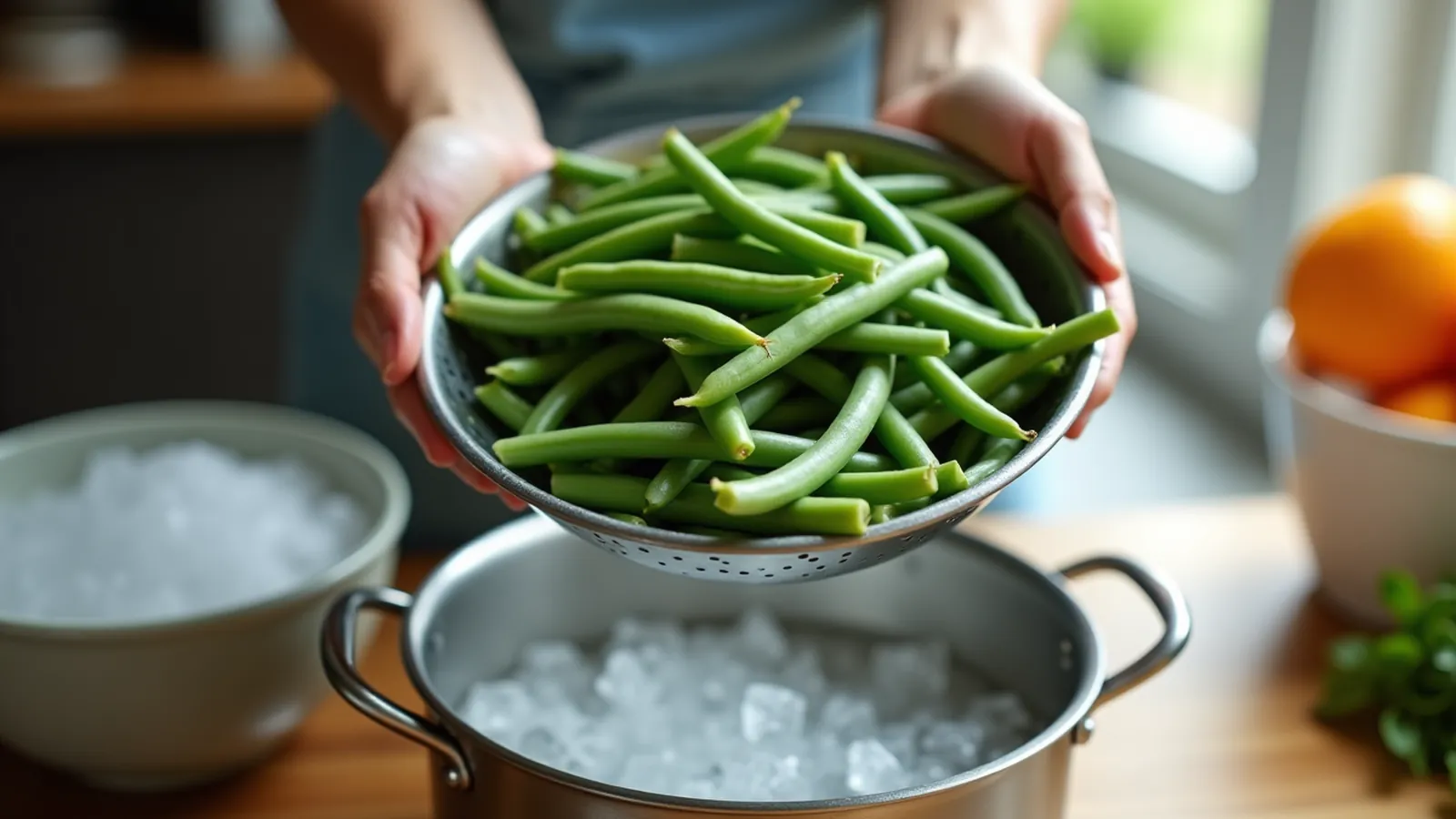
That ratio is NCHFP's, and it's the reason a big harvest takes several rounds. Set up a bowl of ice water next to the stove before you start, so the cooling happens the moment the timer goes.
Done when: the water is at a hard boil and the ice bath is ready.
Lower the basket in, lid on, and start the timer
Use the chart time for that vegetable and size — in boiling water, unless the chart line says steamed. Don't add a minute to be safe: overblanching costs flavor, color, vitamins and minerals, and NCHFP is explicit that both over- and under-blanching are mistakes.
Done when: the timer matches the chart and the water came back to a boil within a minute.
Cool fast, then drain well
Move the vegetables straight into the ice water to stop the cooking, then drain thoroughly. Water left on the pieces turns into ice crystals in the bag and gives you a softer vegetable later.
Done when: the pieces are cold all the way through and the colander has stopped dripping.
Pack, label and freeze flat
Pack into containers or bags, press the air out of bags, and leave the headspace the container maker specifies so the food has room to expand. Write the vegetable and the date on every package, then freeze in a single layer until solid before stacking.
Done when: every package is dated and the freezer is shut.
A household with two raised beds of green beans picks about four pounds in one evening. At one gallon of water per pound, that's four separate blanching batches of three minutes each, plus cooling and packing — under an hour of work, and the season's surplus stops living on the counter. Do that twice a week through the bean flush and the freezer fills without any single long day.
Thawing and using what you froze
Here's the reassuring part: NCHFP states that foods are safe indefinitely while frozen. The clock that matters is quality, not safety — texture and flavor fade over months, and NCHFP publishes recommended storage times for best quality so you can plan rotation instead of discovering a bag of gray beans in two years.
Everything changes the moment the food starts to warm up. NCHFP's warning is specific: as soon as food begins to defrost and becomes warmer than 40 °F (4 °C), any bacteria that may have been present before freezing can begin to multiply, and the outer layer of a package thawing on the counter sits in the danger zone between 40 °F (4 °C) and 140 °F (60 °C), where bacteria multiply rapidly — even while the center is still frozen. So never thaw at room temperature or in warm water.
- In the refrigerator: at 40 °F (4 °C) or less. This is the slowest and safest route, and the one that needs planning.
- In cold running water: under 70 °F (21 °C), with the food in a sealed package.
- In the microwave: only if you're cooking or serving it immediately afterward.
For scale, NCHFP notes that a large frozen item needs at least 24 hours in the refrigerator for every 5 pounds of weight, and even a pound of ground meat or boneless chicken breasts needs a full day. Most frozen vegetables skip this entirely — they go from the bag straight into the pot, which is one of the quiet advantages of freezing over almost any other method.
Where dehydrating fits, and what this chart can't tell you
Drying is the other answer to a zucchini avalanche, and it earns its place: dried food takes shelf space instead of freezer space, and it doesn't care whether the power stays on. But the numbers on this page are blanching times for the freezer, and they are not drying temperatures. Drying times and temperatures depend on the vegetable, how thick you cut it, and the machine you're using, so this page won't invent a chart for it — a made-up number is worse than no number.
What to do instead: follow your dehydrator's manual for the temperature setting, and use your state Cooperative Extension service's guidance for the specific vegetable, which covers whether it should be steam-blanched or blanched in water before drying, and how dry is dry enough. Drying is a good fit for small, firm, low-moisture things you have in quantity, and a frustrating fit for watery ones — a sliced zucchini is mostly water, and it takes a long time and a lot of tray space to get it dry.
Pick one method per vegetable, not per harvest
Freeze the beans, dry the peppers and onions, and pressure can the tomatoes once you're set up for it. Splitting the harvest by method spreads the work across the week and means no single appliance or shelf has to hold everything.
Canning and freezing garden vegetables: which to choose this year
Freezing is forgiving. Canning is tested or it's dangerous, with no middle ground — and the vegetables most gardens overproduce are the ones that need the pressure canner. Green beans, corn, beets, carrots, squash, pumpkin, soups and beans are low-acid foods, and USDA and NCHFP methods require pressure canning with a tested recipe and a processing time adjusted for your altitude. Water-bath canning is for high-acid foods — fruit, pickles, and tomatoes only with the added acid a tested recipe specifies.
Botulism is prevented by exactly three things: a tested recipe, the correct method for that food, and the full processing time adjusted for altitude. If a jar ever looks wrong — bulging lid, spurting liquid, a smell you can't place — throw it out without tasting it, and don't feed it to anyone. Oven canning, open-kettle processing, inversion seals, dishwasher canning, paraffin and steam canning of low-acid food are untested methods; none of them is a shortcut worth taking.
So the honest split for a first season: freeze what the freezer will hold, and put canning off until you have a pressure canner and a tested recipe in front of you. The comparison is laid out in water bath canning vs pressure canning, and pressure canning for beginners covers the setup when you're ready.
"Is this just another affiliate site in a prepper costume?"
It's a fair thing to check, and the answer is on the page: no product is named here, nothing is linked for sale, and every time in the chart traces back to the National Center for Home Food Preservation, whose pages are listed at the bottom so you can open them yourself. The site earns, if at all, from clearly labeled Amazon search links on gear pages and marked affiliate links on review pages — never from a guide quietly pushing a purchase. No food-safety professional reviews these guides, as how we write explains, so the sources are the authority, not us. If a number on this page and a number from NCHFP ever disagree, trust NCHFP.
If you're deciding what to plant with freezing in mind next year, the beginner vegetable garden guide covers succession planting, so the beans and zucchini arrive in waves instead of all at once.
If something goes wrong
- If the water stops boiling when the vegetables go in and doesn't recover in a minute
- You've overloaded the pot. Pull some out, bring it back to a rolling boil, and blanch in smaller batches. That minute is NCHFP's test for the right ratio of water to vegetable.
- If you lost track of time and blanched too long
- The food is still safe to freeze, just softer, paler and lower in vitamins. Label it for soups, sauces and casseroles rather than the plate.
- If you suspect a batch was underblanched
- Don't freeze it and hope. Either cook and eat it now, or blanch it again for the full chart time and then freeze it. NCHFP is clear that underblanching is worse than none.
- If the power goes out while the freezer is full
- Keep the door shut and work through the plan in freezer food safety during a power outage. Never run a generator indoors, in a garage, in a basement or within 20 feet of doors, windows and vents.
- If you find a bag with frost inside and dry, pale pieces
- That's freezer burn, and NCHFP's freezing pointers page explains what causes it and how to keep it from happening next time. Use the package in a cooked dish where texture is less obvious, and press more air out of the bags.
- If you thawed a bag on the counter and forgot it
- Throw it out. Room-temperature thawing puts the outside of the food in the danger zone, and you can't tell by looking. The rules in can you refreeze frozen vegetables cover what to do next.
When to get help
Call for help if
- Anyone gets stomach cramps, vomiting or diarrhea after eating food you preserved, and the symptoms are severe or there are signs of dehydration: call a health care provider, or 911 if it is serious.
- A carbon monoxide alarm sounds while you're blanching on a camp stove or running a generator: get everyone outside first, then call 911 from outdoors. Cooking and generators stay outdoors, never in a kitchen, garage, basement or crawl space.
- You're unsure whether a canning recipe is tested, or your altitude changes the processing time: ask your county Cooperative Extension office or check the National Center for Home Food Preservation directly before you process a single jar.
- You have a jar you don't trust: don't open it to check and don't taste it. Dispose of it so nothing — pets included — can get into it, and ask Extension if you want to know what went wrong.
Who to ask. For home canning, food storage and garden questions, your county Cooperative Extension office can help (see the USDA Cooperative Extension System page); many offices test pressure canner dial gauges. The National Center for Home Food Preservation publishes the tested canning methods and recipes. If anyone who ate home-canned food has trouble seeing, speaking, swallowing or breathing, call 911.
Frequently asked questions
Do you have to blanch vegetables before freezing them?
For almost all vegetables, yes — NCHFP calls blanching a must, because it stops the enzyme action that causes loss of flavor, color and texture. A few vegetables are handled differently on their own NCHFP pages, so check the vegetable before you skip the step. Skipping it isn't a shortcut; underblanching is worse than no blanching at all.
Can you freeze zucchini without blanching it?
NCHFP lists summer squash — the group zucchini belongs to — at 3 minutes of blanching, and that's the number to follow. Zucchini is watery, so freezing it unblanched gives you limp, mushy pieces later. Grate and squeeze it for baking if you like, but blanch it first and freeze it in the amount a recipe uses.
How long do frozen garden vegetables last?
NCHFP states that food is safe indefinitely while frozen, so the limit is eating quality rather than safety. NCHFP publishes recommended storage times for best quality, and the practical approach is to date every package, rotate the oldest forward, and plan to use most of it within the season it was grown.
Which garden vegetables don't freeze well?
Anything you eat raw and crisp is a disappointment after freezing — lettuce, cucumber and radishes turn limp and watery. NCHFP keeps a separate page on foods that do not freeze well, and it's worth a look before you fill a bag. Cooked dishes, sauces and soups made from those vegetables freeze far better than the raw vegetable does.
Is freezing vegetables safer than canning them?
They're different risks. Freezing has no botulism risk while the food stays frozen, but it depends on power and on safe thawing. Canning low-acid vegetables safely requires pressure canning with a tested recipe, the full time and an altitude adjustment; done that way it's reliable, and done any other way it isn't. Freezing is simply the easier one to do correctly this season.
What about dehydrating the same vegetables instead?
Drying is a good second method, but the temperatures and times come from your dehydrator's manual and your state Cooperative Extension's guidance for that vegetable — not from a blanching chart. This page sticks to the freezer times NCHFP publishes rather than printing drying numbers it can't source, and your Extension office will tell you whether a given vegetable needs blanching before it dries.
Sources
- Blanching Vegetables, National Center for Home Food Preservation (accessed October 31, 2026).
- Blanching Times, National Center for Home Food Preservation (accessed October 31, 2026).
- Thawing and Preparing Foods for Serving, National Center for Home Food Preservation (accessed October 31, 2026).
- How Long Can I Store Frozen Foods?, National Center for Home Food Preservation (accessed October 31, 2026).
- Freezing Pointers, National Center for Home Food Preservation (accessed October 31, 2026).
Keep the harvest in the right order
The Food and Water section puts freezing, canning, root storage and rotation side by side, with the safety numbers cited on every page.