
Kits & Plans
Pet friendly shelters: where to go with a dog when you have to leave
If the order comes and you don't know which shelters take dogs, staying home starts to look like the safer choice. Build the list now, so the dog goes with you.
On this page (11 sections)
- Build the list in six steps
- How to find pet friendly emergency shelters near me
- What shelters require at the door
- The car evacuation kit for one dog
- Pet friendly storm shelters and the short-notice problem
- When the shelter cannot take your dog
- Troubleshooting
- When to get help
- Frequently asked questions
- Next in the manual
- Sources
You live near a flood zone, the county says to leave, and the one question you cannot answer is which pet friendly shelters will take the dog. If nobody will take him, staying home starts to feel like the responsible choice, even when the water is the bigger risk.
The answer is not a secret list that appears when a warning is issued. It is a short list you build on an ordinary afternoon: two phone numbers, three or four places that will take both of you, and a tote in the car with the paperwork a shelter will ask for at the door. Here is how to put that together before you ever need it.
Key takeaways
- The American Red Cross is direct about this: if it's not safe for you to stay behind, it's not safe to leave pets behind either.
- At a Red Cross shelter, workers do all they can to accommodate household pets, but depending on the situation, pets may need to be housed in a different location with support from animal welfare groups. Service animals that assist people with disabilities are always welcome.
- Ready.gov's pet guidance is to plan shelter alternatives in advance that work for both you and your pets, because animals may not be allowed inside a public shelter.
- Know which hotels and motels along your evacuation route accept pets, call ahead if you may need to leave, and ask whether a no-pet policy could be waived in an emergency (American Red Cross).
- Many pet shelters require proof of current vaccinations (American Red Cross), so gather records before the warning, not during it.
- Carry current photos of you with your pet, feeding schedules, medical and behavior notes, and medications with copies of medical records in a waterproof container (American Red Cross).
Do this before the next storm
- Call your county emergency management office and ask which shelters in their plan accept pets, and where pets are housed if they cannot come inside.
- Write down one friend or relative outside the flood zone who will take the dog, and one hotel that allows pets on your likely route (Ready.gov, American Red Cross).
- Photocopy the vaccination record, put it in a zip bag, and drop it in the car tote (American Red Cross).
Things this guide mentions
Amazon searches, not product picks: we have not tested what they show. Check the specs and the return policy on each listing before you buy.
Build the list in six steps
Work through this once, on a calm day, and you will not be making these calls with a weather alert on your phone.
Start with your county emergency management office
The number is on your county's website, usually under emergency management or public safety. Ask two questions: which shelters in the county plan accept pets, and where pets are housed when a shelter cannot take them inside. Note who you spoke with and when.
Done when: you have a name, a phone number and a yes-or-no answer for at least one shelter.
Call your local Red Cross chapter and animal control
The Red Cross says shelter workers do all they can to accommodate household pets, but depending on the situation, pets may be housed at a different location with support from animal welfare groups (American Red Cross). Your local animal control agency or shelter can tell you who runs that pet housing in your area.
Done when: you know the likely location for displaced pets and who to ask on the day.
Add a hotel and a boarding option
The Red Cross suggests knowing which hotels and motels along your evacuation route accept pets, calling ahead for reservations, and asking whether a no-pet policy could be waived in an emergency. The AVMA's suggested contact list adds an alternate veterinarian 30 to 90 miles away who provides boarding, a local boarding facility, and hotels that allow pets within a 90-mile radius (American Veterinary Medical Association).
Done when: one hotel and one boarding facility are written on the list with phone numbers.
Note the service-animal rule separately
Service animals that assist people with disabilities are always welcome in Red Cross shelters. If that applies to your household, say so when you call, and ask what documentation the shelter will want.
Done when: the shelter knows a service animal is coming and what to bring.
Write it on one page
Put every option, address, phone number and note on a single sheet. Tape one copy inside a kitchen cabinet, photograph it, and put a copy in the car tote. The AVMA suggests keeping a copy of your pet emergency contact list with your evacuation kit.
Done when: the sheet exists in three places and everyone in the household can find it.
Practice once
The Red Cross suggests including your pets in evacuation drills so they become used to entering and traveling in their carriers calmly. A five-minute drill in the driveway tells you whether the carrier still fits.
Done when: the dog has been in the carrier this year and the carrier is in the car or by the door.
How to find pet friendly emergency shelters near me
The sources we cite do not publish one national list of pet-accepting shelters, so what you build is a local one: your county office, your Red Cross chapter, animal control, and a couple of businesses that will take a dog. Ready.gov frames it the same way. If you must evacuate and go to a public shelter, animals may not be allowed inside, so its guidance is to plan in advance for shelter alternatives that work for both you and your pets, including friends or relatives outside your immediate area who would host you and your pets.
Two habits make the search fast. Start with your county emergency management office rather than a general search engine. And ask the question as "where do pets go if the shelter can't take them," not "do you take pets." The second version gets you a location instead of a no.
| Option | What to confirm | Best for |
|---|---|---|
| Friend or relative outside the flood area | That the dog is welcome, for how many days, and whether other pets live there | The calmest place for the dog; costs nothing |
| Pet-friendly hotel or motel on your route | Pet fees, size or breed limits, and whether a no-pet policy could be waived in an emergency (American Red Cross) | Short notice, when shelters are full |
| Boarding facility or veterinarian outside the flood zone | Space, vaccination requirements, hours, and how you would get there (AVMA contact list) | When your destination cannot take the dog |
| County pet shelter or co-located pet housing | Where it is, who runs it, and what check-in requires; the Red Cross notes pets may be housed at a separate location with animal welfare groups | When you need the county's own plan |
| Red Cross shelter | Whether household pets can be accommodated and where they would be housed; service animals are always welcome | Basic shelter for people, with the dog's spot confirmed separately |
Fill in your own version of this table with real names and phone numbers. A blank table is a plan; a table with your county's shelter and your sister's address on it is a solution.
What shelters require at the door
Pet housing has rules, and most of them are about disease control and identification, not about being difficult. The American Red Cross notes that many pet shelters require proof of current vaccinations to reduce the spread of disease, and that dogs and cats should wear collars with securely fastened, up-to-date identification.
The Red Cross also suggests keeping vaccinations current, considering having your pet microchipped by your veterinarian, and preparing a short information sheet: feeding schedules, medical conditions, behavior problems, and your veterinarian's name and number, in case you have to foster or board your pets.
- Vaccination record, photocopied and in a zip bag (American Red Cross)
- Collar with current ID tag, plus a microchip number if your dog has one (American Red Cross)
- Current photos of you with your dog, in case you are separated (American Red Cross)
- Medications and copies of medical records, in a waterproof container (American Red Cross)
- A one-page sheet with feeding schedule, medical conditions, behavior notes and your vet's phone number (American Red Cross)
- Bedding and a familiar toy, if they are easy to carry (American Red Cross)
- A pet rescue sticker for your home window, with the number and type of pets and your vet's phone; if you evacuate and time allows, write "EVACUATED" across it (American Red Cross, citing the ASPCA)
Ask your county contact whether they want originals or copies, and whether a rabies certificate specifically is required. Write the answer on your one-page list.
The car evacuation kit for one dog
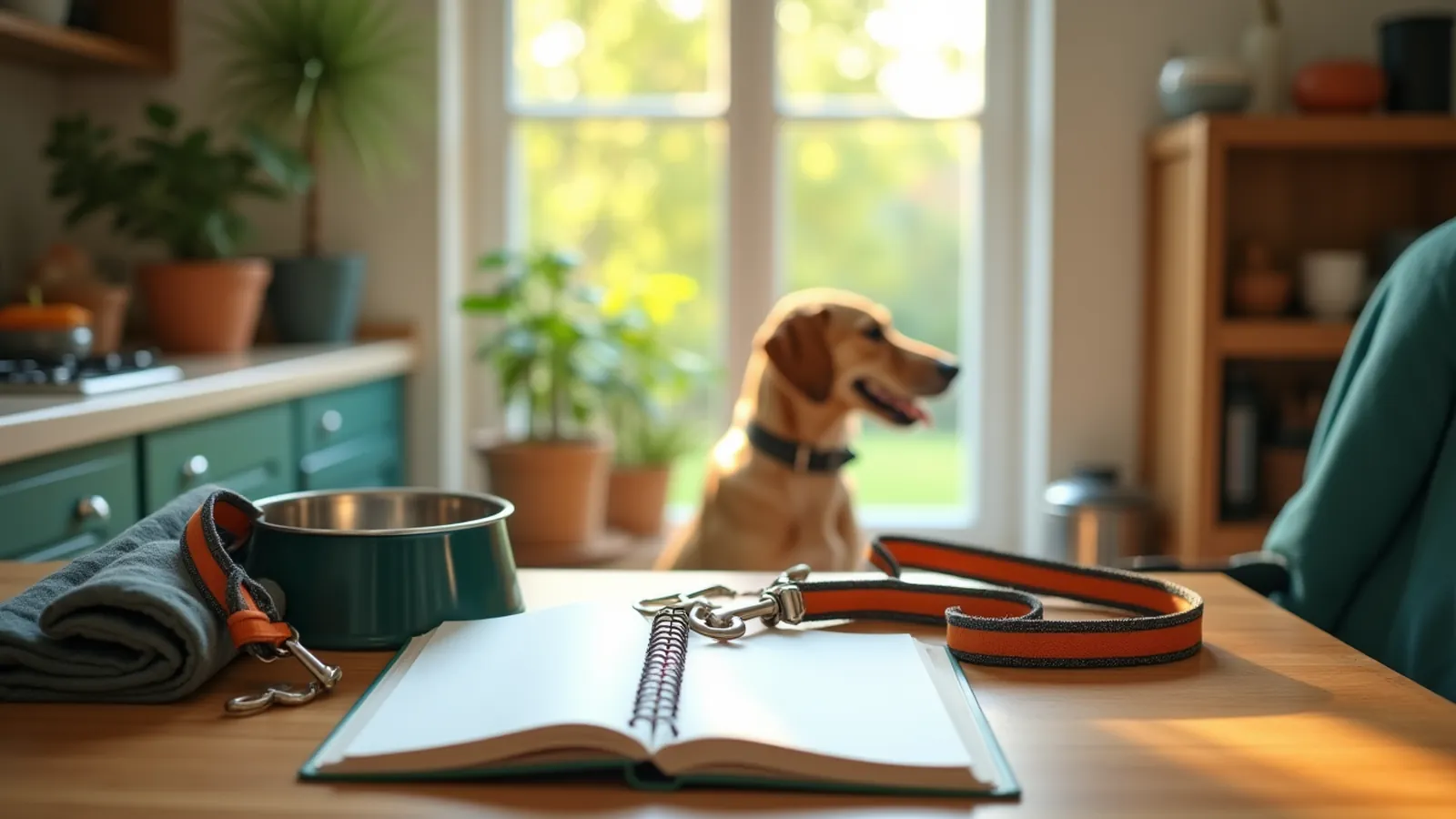
This is a small tote plus a carrier, not a second household. It lives in the car from spring through fall if you can spare the space, and by the door if you cannot. The labeled items below are from the Red Cross pet-supply list; the rest are plain extras you add yourself, not requirements from any agency.
- Food for the days you expect to be away (American Red Cross)
- Medications and copies of medical records in a waterproof container (American Red Cross)
- A first aid kit for pets (American Red Cross)
- Current photos of you with your dog (American Red Cross)
- The information sheet: feeding schedule, medical conditions, behavior problems, vet name and number (American Red Cross)
- Bedding or a familiar blanket, and one toy, if easily transportable (American Red Cross)
- Collar with up-to-date ID and a copy of the vaccination record (American Red Cross)
- Extra you add: a leash, a folding bowl, a bottle of water, waste bags, paper towels and a spare towel
- Extra you add: a carrier or crate the dog fits in today; the Red Cross suggests practicing with carriers so pets travel calmly
- Extra you add: an emergency contact list built the AVMA's way, with your vet, an alternate vet 30 to 90 miles away, boarding facilities and pet-friendly hotels within 90 miles
- Extra you add: your one-page shelter list, so the plan travels with the dog
Budget note
Most of this is already in your house: a spare leash, an old towel, a plastic tote, a photocopy of the vaccination record. If you are missing a carrier, a soft-sided one folds flat in a trunk. Search links if you need them: soft-sided pet carriers (Amazon, affiliate link) opens in a new tab and waterproof document pouches (Amazon, affiliate link) opens in a new tab. This site does not rank brands, quote prices on gear pages or claim to have tested any product.
The pet emergency kit guide covers the fuller version you keep at home, and the 72-hour kit checklist shows where the dog's bag fits alongside the family tote.
Pet friendly storm shelters and the short-notice problem
Storm shelters open on short notice, so ask your county in advance whether pets are accepted when a shelter opens (Ready.gov). That makes storm sheltering a phone call you make now, written on your sheet, instead of a parking-lot decision later.
If the answer is no, the practical fallback is a sturdy interior room at home for short events, and a pre-arranged pet-friendly destination for anything longer. The Red Cross guidance still applies: if it isn't safe for you to stay behind, it isn't safe to leave pets behind either. Plan the drive, not the goodbye.
Households with more than one animal should be ready to house them separately. The Red Cross notes that although animals may be more comfortable together, you should be prepared to house them separately.
When the shelter cannot take your dog
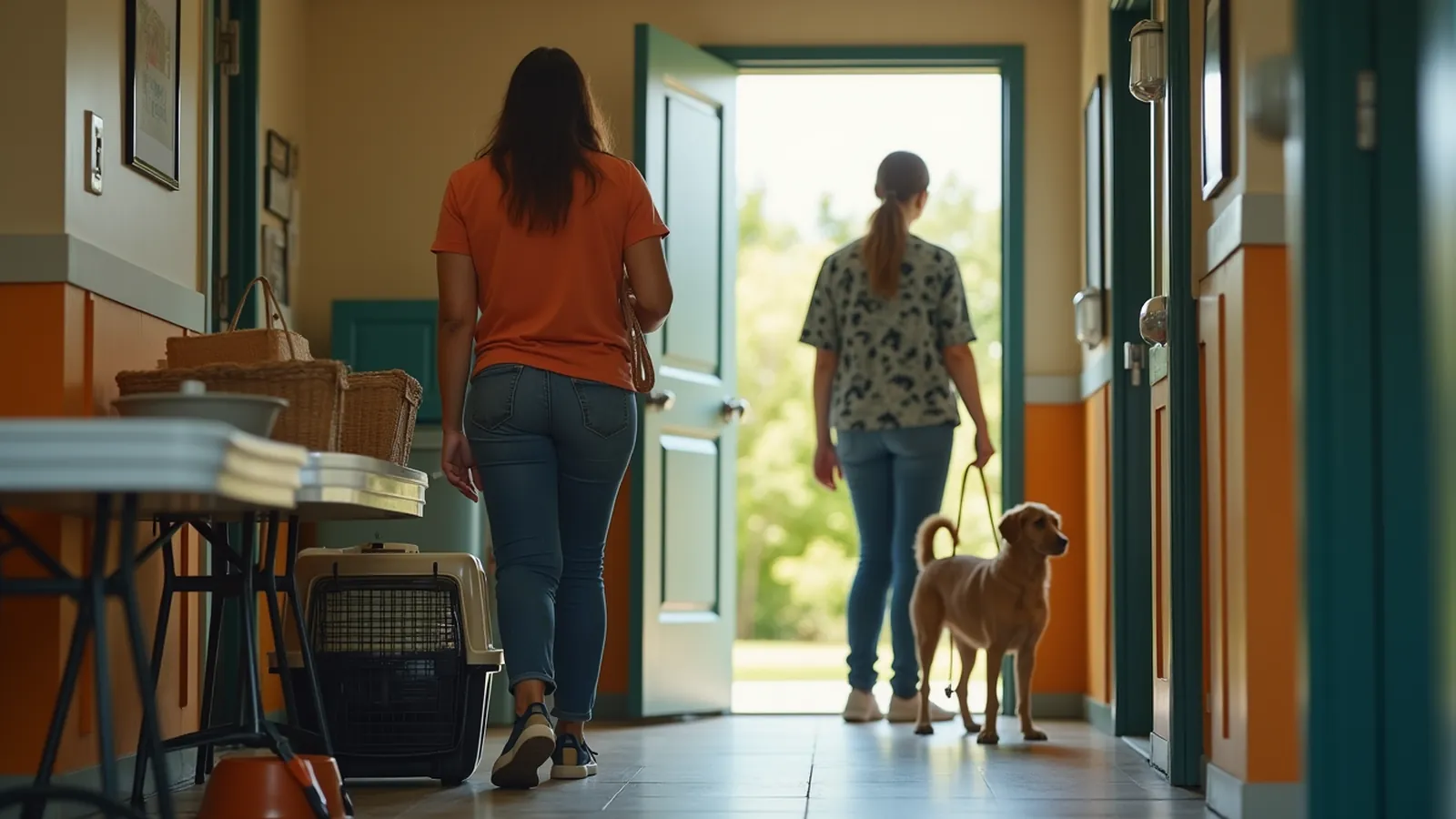
This is where the list earns its keep. If the first shelter turns you away, you already know the next call: the boarding facility 30 to 90 miles out, the pet-friendly hotel on your route, or the relative outside the flood zone.
Ask where pets are being housed, not just for a no
The Red Cross notes pets may be housed at a different location with support from animal welfare groups. Ask for that location and how to get there before you leave the check-in line.
Done when: you have an address or a firm no.
Call your pre-arranged option from the car
Use the hotel or boarding facility on your sheet. Calling ahead is what the Red Cross suggests for hotels along your evacuation route.
Done when: someone has confirmed a space for the dog.
Split the household if you must
One adult takes the dog to the confirmed option while the other takes the kids to the shelter. Decide this in advance so nobody is arguing in a parking lot.
Done when: both adults know which role is theirs.
Keep the dog with you while you check in
Take turns waiting outside with him rather than leaving him alone in a parked car, especially in warm weather.
Done when: nobody is left in the car alone.
A household with two adults, two kids and one dog lives two blocks from a creek that floods. Their one-page sheet lists the county shelter, a co-located pet housing site run with a local animal welfare group, a motel 40 miles inland that takes dogs, and a boarding facility 60 miles away. When the order comes, one adult drives the dog to the motel, the other takes the kids to the county shelter, and they meet for breakfast. Nothing about that morning requires a decision.
Troubleshooting
- If your county says none of its shelters take pets
- Ask specifically where pets are housed when a shelter opens. The Red Cross notes pets may be housed at a different location with animal welfare groups. Then put a hotel and a boarding facility on your sheet.
- If your dog isn't current on vaccinations
- Call your veterinarian now and ask what can be brought up to date. Many pet shelters require proof of current vaccinations (American Red Cross).
- If your dog is anxious or reactive
- Say so on your information sheet and to shelter staff on arrival. The Red Cross notes a pet's behavior may change after a disaster, becoming aggressive or defensive, so plan for a carrier and for keeping him under direct control.
- If a hotel says no pets
- Ask whether the no-pet policy could be waived in an emergency (American Red Cross), and move to the next number on your list.
- If the carrier does not fit in the car
- Use a leash and a harness for the drive and ask the shelter or boarding facility what they can provide on arrival.
When to get help
Call for help if
- Anyone in the household is in danger during an evacuation or storm: call 911.
- You cannot physically evacuate with the dog, or you have nowhere to go: call your county emergency management office and ask about assistance before the water rises.
- Your dog is injured, ill or showing signs of stress after an emergency: contact your veterinarian, as the AVMA advises.
Who to ask. For your pet's health, medications and records, call your veterinarian. For shelters that accept pets and local evacuation plans, contact your city or county emergency management office (start at Ready.gov). In an emergency, call 911.
Frequently asked questions
Are there pet friendly emergency shelters near me?
Whether a pet can be housed depends on your county's plan, which is why you confirm it by phone before you need it. Start with your county emergency management office, then call your local Red Cross chapter and animal control. Ask which shelters accept pets and where pets are housed when they cannot come inside. Ready.gov suggests planning those shelter alternatives in advance.
Do Red Cross shelters accept pets?
Red Cross shelter workers do all they can to accommodate household pets, but depending on the situation, pets may need to be housed in a different location with support from animal welfare groups. Service animals that assist people with disabilities are always welcome in Red Cross shelters. Ask your local chapter what to expect in your area.
What should I bring for my dog at a shelter?
Proof of current vaccinations, a collar with up-to-date ID, food, and medications with copies of medical records in a waterproof container. Add current photos of you with your dog, a one-page sheet with feeding schedule, medical conditions, behavior notes and your vet's phone number, plus bedding and a toy if easy to carry (American Red Cross).
Where can I find pet friendly storm shelters?
Storm shelters open on short notice, so ask your county emergency management office in advance whether pets are accepted when a shelter opens (Ready.gov). If no nearby storm shelter takes pets, plan a sturdy interior room at home for short events and a pre-arranged pet-friendly destination for longer ones.
Can I leave my dog home if I evacuate?
The American Red Cross is clear that if it's not safe for you to stay behind, it's not safe to leave pets behind either. The safer plan is to evacuate the dog with you, using a pre-arranged friend, hotel, boarding facility or pet housing location on your list.
How do I know this is not just an affiliate site in disguise?
It is a fair question. The food-preservation guides follow USDA and National Center for Home Food Preservation tested methods, each page lists its sources with an access date, and the how we write page explains the process, including that no food-safety professional reviews the guides. Where gear appears, it is a labeled Amazon search link so you can compare options yourself. The family emergency plan is free to use either way.
Ready to compare?
The same searches, in one place. Use the checklist in this guide when you compare listings, and buy only what fills a gap in what you already have.
Sources
- Pet Disaster Preparedness, American Red Cross (accessed October 29, 2026).
- Pets and Disasters, American Veterinary Medical Association (accessed October 29, 2026).
- Pets and Animals, Ready.gov, FEMA (accessed October 29, 2026).
- Evacuation, Ready.gov, FEMA (accessed October 29, 2026).
- Disaster Preparedness, ASPCA (accessed October 29, 2026).
The kit, the plan and the dog
The kits and plans section puts the pet kit, the family plan and the 72-hour kit in the order you will actually use them.