
Food & Water
Food-grade 55 gallon water barrel: markings to check before you buy
You want more water stored than a shelf of jugs will hold, and every 55-gallon drum online looks the same. Here is how to tell a food-grade barrel from an industrial one, judge a used drum, and clean it the way the FDA describes before the first fill.
On this page (12 sections)
- What food grade means on a plastic 55 gallon barrel
- The checklist to verify before you pay
- Used 55 gallon barrels: where they come from and how to judge one
- Where to find a water barrel 55 gallon size on a budget
- The 55 gallon barrel with lid: bungs, gaskets and fittings
- Cleaning and sanitizing a barrel before the first fill
- How far one 55-gallon barrel goes
- If something goes wrong
- When to get help
- Frequently asked questions
- Keep going
- Sources
You need more water stored than a shelf of jugs will hold, so you're looking at a 55 gallon water barrel — and every listing photo looks the same. Blue drum, white drum, one title says "food grade," another says "industrial," and nothing on the screen tells you which one you can put drinking water in. That wariness is right. The barrel is the easy part; the markings and the barrel's history decide whether it belongs in your kitchen.
What follows is a checklist, not a product pick: what the words on a barrel actually mean, how to judge a used drum, where to look on a budget, and the washing and sanitizing steps the FDA publishes before a first fill. We don't sell barrels and haven't tested one — the goal is that you can open a listing or walk into a farm store and know within a minute whether to buy.
Key takeaways
- "Food grade" describes the plastic and the barrel's history: a food-grade resin barrel that spent years holding machine oil is not a water barrel.
- The number in the triangle tells you the plastic family, not whether the barrel is safe. Industrial drums carry the same code.
- Any barrel marked "not for food contact" or "industrial use only" is out, at any price.
- For a used barrel, documentation beats smell. No record of what it held means no drinking water.
- The FDA's sanitizing solution for food-contact surfaces is 1 tablespoon of unscented household bleach per gallon of water, for 15 minutes.
- A 55-gallon barrel is too heavy to move once it is full, so fill it where it will live.
Things this guide mentions
Amazon searches, not product picks: we have not tested what they show. Check the specs and the return policy on each listing before you buy.
What food grade means on a plastic 55 gallon barrel
"Food grade" isn't a look. A blue barrel, a white barrel and a translucent barrel can each be a drinking-water container or a drum that hauled industrial soap. The phrase covers two separate things, and a barrel has to pass both: the plastic is made to meet FDA food-contact requirements, and the barrel is new or has only ever held food, with something in writing to prove it.
Most people stop at the number inside the triangle stamped near the bottom, and that is the least useful part. Code 2 means high-density polyethylene (HDPE), which is what most water barrels are made of — and also what industrial drums, milk jugs and detergent bottles are made of. It tells you the plastic family, nothing about the barrel's rating or its past.
| What you see | What it means | Your move |
|---|---|---|
| "Food grade," "FDA-compliant" or "meets FDA requirements for food contact" on the barrel or the maker's spec sheet | The maker is claiming the resin meets food-contact rules | Keep the spec sheet; a phrase in a listing title is not a marking on the drum |
| Resin code 2 (HDPE) | The plastic family: high-density polyethylene | Necessary, not sufficient — industrial drums are HDPE too |
| "Not for food contact," "industrial use only" or "do not use for potable water" | The maker is saying no | Pass, no matter how good the price is |
| A former-contents label, hazard diamond or shipping marks | The barrel had a working life before you | Treat the history as unknown unless you have documentation |
| Lid, ring, gasket and bung style | Decides whether you can close it, vent it and get water out | Confirm the closures are included, undamaged and food-grade |
The checklist to verify before you pay
Whether the barrel is across town or arriving on a pallet, these are the questions that separate a water barrel from a drum. Run the list on the page itself, then keep the seller's answers.
- The words food grade, FDA-compliant or "meets FDA requirements for food contact" appear on the barrel or its spec sheet — not only in the listing title.
- You know who made it and can find the barrel's product page.
- It is new, or the seller will put in writing what it held before.
- There is no "not for food contact," "industrial use only" or "do not use for potable water" anywhere on it.
- The resin code is 2, and the seller confirms the resin is food-contact grade rather than regrind of unknown origin.
- The lid, ring, gasket and bungs are included, undamaged and food-grade.
- There are no cracks, no repairs, and no smell you can't identify — and you are not counting on washing one out.
- You have measured the doorway, the stairs and the spot where it will sit, and you know the return policy.
If a seller can't get through that list, take it as the answer and move on. Asking for a spec sheet is normal, not fussy: food-grade barrel sellers deal with breweries, farms and bottlers who ask exactly this before every order.
Used 55 gallon barrels: where they come from and how to judge one
Most cheap drums online are one of two things: new shipping barrels never meant for drinking water, or used barrels emptied of whatever they carried. The second kind is where the bargains and the mistakes both live.
Used barrels come out of food plants (syrup, juice, vinegar, brine, olive oil), soap and detergent works, car washes and garages. Food-plant drums are the ones worth considering, and only with documentation. Ask what exactly was in it, whether that was a food or a drink, whether the seller will put that in writing, and how it was stored after it was emptied. A barrel that held soap, car-wash detergent, fragrance or fuel is not a drinking-water candidate, because plastic absorbs what it holds and no amount of scrubbing lets you verify otherwise at home.
| Former contents | Drinking water? | Why |
|---|---|---|
| Syrup, juice, vinegar, brine or olive oil, from a food plant, documented | Possible, after washing and sanitizing | Food residue can be cleaned; the paperwork is what makes the barrel knowable |
| Soap, detergent, car-wash chemicals or fragrance oils | No | These soak into plastic and leave a residue you cannot scrub out or test for |
| Fuel, oil, hydraulic fluid, pesticides or anything unknown | Never | A faint residue is a risk you cannot see, smell reliably or check at home |
| New, food-grade, with the maker's spec sheet | Yes, after washing and sanitizing | Nothing has been stored in it yet |
Two cautions. A rain barrel is usually a used drum with a spigot added, and rain barrel water belongs on the garden, not in the kitchen. And a smell test proves nothing either way: a barrel can smell of nothing and still have carried something you would not want in drinking water.
Where to find a water barrel 55 gallon size on a budget
Shipping is the line item that decides this. A 55-gallon drum is bulky and fairly light, the worst combination for freight, so compare listings by the delivered price with the lid included, not by the number on the product card.
Look locally first: farm and ranch stores, homebrew and winemaking shops (they sell food-grade drums for juice concentrate), food-processing plants and bottlers that sell their empties, and a county or city rain-barrel program if yours has one — asking, in every case, what those drums held before. Then compare one new, documented barrel against two or three cheap unknowns. One barrel you can account for beats three you can't, and it takes a quarter of the floor space.
Spend the fittings budget on closures rather than accessories: a lid with an intact gasket, or a pair of bungs and a wrench to open them, matters more than a spigot you will have to keep clean. If you'd rather start with a search than a phone call, use this one and hold each listing against the checklist above.
Search food-grade 55 gallon water barrels on Amazon (Amazon, affiliate link) opens in a new tab
Why there's no barrel pick on this page
We don't name a best barrel, because we haven't bought or tested one, and a guide that pretends otherwise is a sales page. The site earns, if at all, from labeled Amazon search links like the one above and clearly marked affiliate links on review pages. The canning guides follow tested USDA and National Center for Home Food Preservation methods — pressure canning for low-acid foods at the pressures and times those sources publish, adjusted for altitude — and nothing here recommends oven canning, open-kettle processing, inversion seals or other untested shortcuts. No food-safety professional reviews these guides, as how we write explains, and every page lists its sources so you can open them yourself.
The 55 gallon barrel with lid: bungs, gaskets and fittings
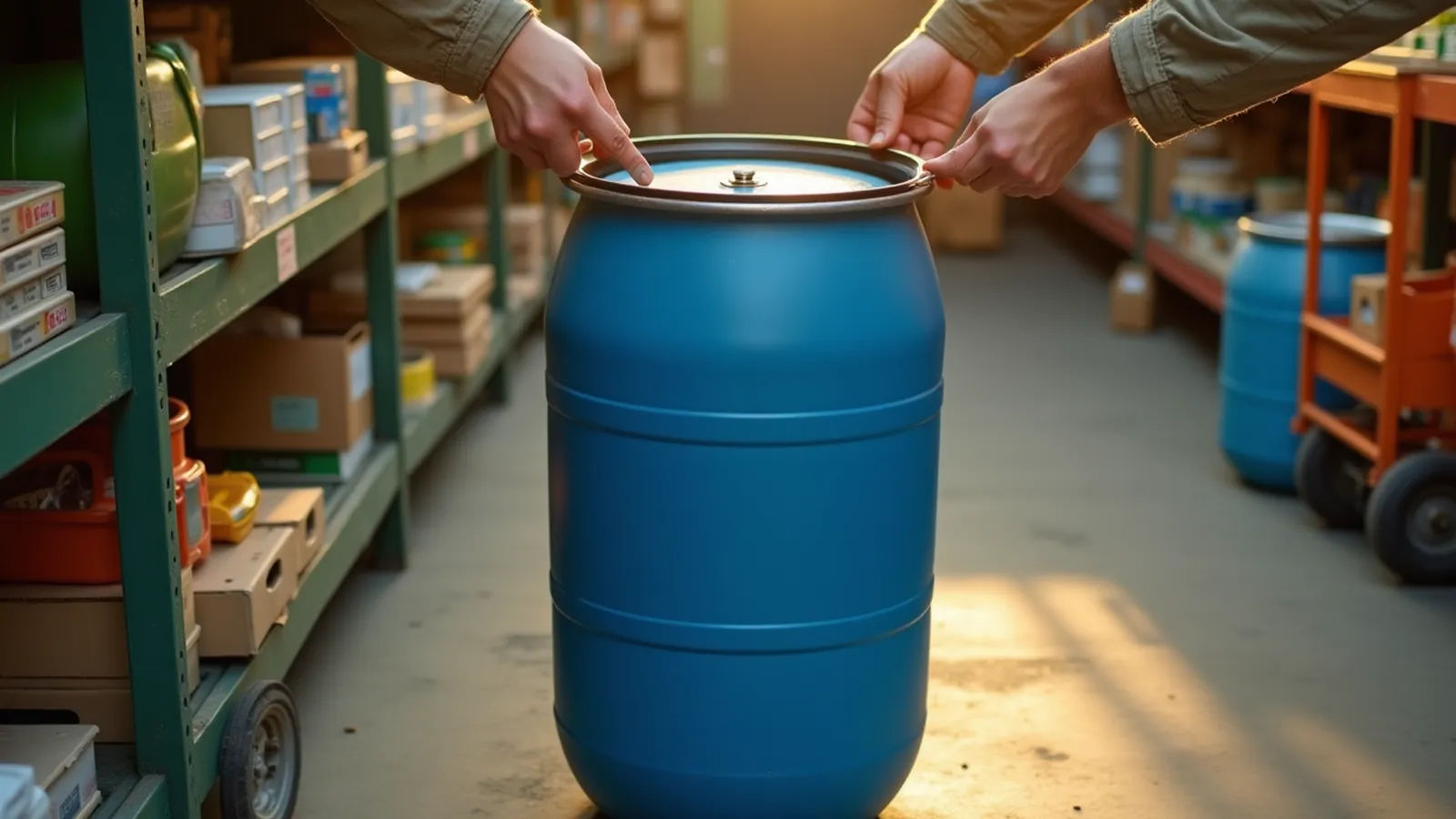
Two shapes matter. An open-head barrel has a full-diameter lid held on by a ring; a closed-head, or tight-head, barrel has a small fill opening and a small vent opening, each closed with a bung.
- Open head: easiest to scrub, rinse and air dry, and the lid keeps dust and insects out. The ring and gasket are the parts that fail, so check both before you pay.
- Closed head: a better seal, harder to clean because you are working through a small hole. You need a bung wrench, and you leave one bung loose while you draw water so the barrel can vent.
- Spigots: add only one you can take apart and sanitize, and plan for a stand if you want gravity to do the work. A spigot you can't clean is a place for things to grow.
- Drying and placement: store the lid or bungs off until the inside is bone dry, then fit them, and keep the barrel out of direct sunlight.
Cleaning and sanitizing a barrel before the first fill
New or used, a barrel gets washed and then sanitized. Washing removes what you can see; sanitizing is the step people skip.
Put it where it will live — empty
A full barrel is not something you carry across a garage, and lifting one is how they crack.
Done when: the barrel is on its final spot and you have measured the space around it.
Wash every surface with soap and warm water
Inside walls, the bottom, the lid, the ring and the bung threads. A soft brush on a handle reaches the bottom of a drum better than a rag. Rinse until no suds remain.
Done when: the rinse water runs clear and the barrel doesn't smell of soap.
Mix the FDA sanitizing solution
One tablespoon of unscented household bleach per gallon of water — the strength the FDA gives for sanitizing utensils and food-contact surfaces. You don't need 55 gallons: mix a few, cap the barrel, and roll and rock it so the solution coats every inside surface, threads and lid included.
Done when: every surface has been wet with the solution, including the parts you can't reach by hand.
Let it stand 15 minutes
That is the FDA's contact time for dishes and utensils in the same solution. Roll the barrel once partway through so the top walls get their turn.
Done when: the timer has run out and the bungs and lid have had their soak too.
Drain, rinse and air dry completely
Rinse with clean water and leave it open to dry out of the sun. Moisture sealed inside a barrel is what makes the first batch of stored water taste and smell wrong.
Done when: the inside is dry to the touch, not just drained.
Fill from a source you trust, then date it
Municipal tap water that isn't under a notice, commercially bottled water, or a well you've had tested. Cap it and write the fill date on the barrel in marker so rotation isn't a guess.
Done when: the barrel is full, sealed and labeled with the date.
Read the bleach bottle first
The FDA's figures are written for unscented household liquid bleach at about 5.25% sodium hypochlorite, and many bottles now print 6% or 8.25% instead. Never use scented, splashless, color-safe or cleaner-added bleach, and never mix bleach with other cleaners. If your bottle shows a different strength, use the dose chart in how to disinfect water with bleach rather than guessing.
Where the water comes from matters more than which barrel it goes into. If the source is questionable, treat water in small batches rather than trying to dose 55 gallons at once: the FDA's rule is a 1-minute boil, or 8 drops (1/8 teaspoon) of unscented household bleach per gallon with a 30-minute wait. The doses are in the bleach dose chart, and if your tap water is under an advisory, what to boil, bottle and skip covers what changes.
How far one 55-gallon barrel goes
Ready.gov's starting point is at least one gallon of water per person per day for several days, for drinking and sanitation, and more than that if you have room to store it. A barrel is one way to buy that margin in a single container.
A household of four, planning on one gallon per person per day, is four gallons a day. Fifty-five gallons covers about 13 days of drinking water before pets, cooking and dishes are counted. Two barrels would cover roughly a month — and splitting storage between two means a leak or a cracked lid costs you half your supply instead of all of it.
Decide two things before you fill it: where it sits (sturdy, near where you'd use the water, out of sun, not in a shed that freezes, with headspace if freezing is possible), and how you'll get water out — a clean ladle kept with the barrel, a hand pump, or a spigot on a stand. Whatever you use, don't dip in a cup that's been in someone's mouth.
Sizes and rotation are in emergency water storage, and how to choose water storage containers covers jugs to keep alongside the barrel. If the reason you're buying barrels is a pump that quits when the power does, does a power outage affect water covers the first three days.
If something goes wrong
- If the stored water smells or tastes off when you open the barrel
- Dump it. Wash and sanitize the barrel again using the steps above, then refill from a source you trust. Don't test a smell you can't explain by drinking it.
- If you can't document what a used barrel held
- Retire it to the garden or the garage. Never for drinking water, no matter how well it cleaned up.
- If the lid weeps or the barrel bulges
- Open it slowly, check the gasket and the bung threads, and move it out of a hot shed or direct sun. A sealed barrel in a hot space builds pressure you don't need.
- If the barrel might freeze
- Leave headspace so ice has somewhere to expand, and check the barrel midwinter rather than in spring.
- If your tap water comes under a boil water advisory after you filled
- The barrel water is still fine; the tap isn't. Switch drinking, ice and dishes to the stored water and follow the notice.
When to get help
Call for help if
- Anyone gets stomach cramps, vomiting or diarrhea, or shows signs of dehydration, after drinking stored water: call a health care provider, or 911 if it is serious.
- A carbon monoxide alarm sounds while you're boiling water on a camp stove or grill to treat it: get everyone outside first, then call 911 from outdoors. Cook and boil outdoors only — never in a kitchen, garage, basement or crawl space (CDC).
- Your well was flooded or the casing or pump was damaged: contact your local or state health department or agricultural extension agent for advice on testing and disinfecting after the water recedes (FDA).
- The notice for your water system says not to use the water for anything: follow it exactly and call the number on the notice before you use a drop.
Who to ask. In an emergency, call 911. If a carbon monoxide alarm sounds or anyone feels dizzy, sick or confused, get everyone outside into fresh air first, then call 911. Report outages and downed power lines to your utility. For local hazards, shelters and alerts, contact your city or county emergency management office (start at Ready.gov).
Frequently asked questions
How can I tell if a 55 gallon water barrel is food grade?
Look for the words food grade, FDA-compliant or "meets FDA requirements for food contact" on the barrel itself or the manufacturer's spec sheet, plus resin code 2. Then confirm the history: new, or used only for food and documented. A listing title alone proves nothing, and "industrial use only" means it is not a water barrel at any price.
Can I use a used 55 gallon barrel for drinking water?
Only if you know what it held and can get that in writing — a food plant's syrup, juice, vinegar or oil drum is the realistic case. Anything that held soap, detergent, fragrance, fuel or an unknown is out. A smell test proves nothing either way, and even a documented food barrel gets washed and sanitized before its first fill.
Does a 55 gallon barrel with lid need a liner?
A barrel that is genuinely food-grade doesn't need one, and a liner doesn't rescue a barrel that held the wrong thing. If you do use a liner bag, it has to be food-grade itself and fit without tearing on the threads. Plain and clean beats clever here.
How do I clean a plastic 55 gallon barrel before filling it?
Wash it inside and out with dish soap and warm water, including the lid, ring and bung threads, and rinse. Then coat the inside with 1 tablespoon of unscented household bleach per gallon of water, rolling the barrel so every surface is wet, and let it stand 15 minutes. Drain, rinse, air dry completely, then fill and write the date on it.
How long does water stay good in a barrel?
There's no single answer that fits every barrel, because it depends on the water you put in and how clean and sealed the container was. Write the fill date on the barrel, keep it out of sunlight, use clean utensils to draw water, and rotate on a schedule you'll actually keep.
Ready to compare?
The same searches, in one place. Use the checklist in this guide when you compare listings, and buy only what fills a gap in what you already have.
Sources
- Food and Water Safety During Power Outages and Floods, U.S. Food and Drug Administration (accessed October 30, 2026).
- Water, Ready.gov, FEMA (accessed October 30, 2026).
- Carbon Monoxide (CO) Poisoning Basics, Centers for Disease Control and Prevention (accessed October 30, 2026).
- Storing Home Canned Foods, National Center for Home Food Preservation (accessed October 30, 2026).
- Ensuring Safe Canned Foods, National Center for Home Food Preservation (accessed October 30, 2026).
Water storage, in the right order
The Food and Water section puts storing, treating and rotating water in order, with the containers and boil-water guides next to it.